
Rice as a System: Structure, Starch, Function and Cooking
Rice is not a single ingredient but a structural system shaped by starch composition and grain morphology. From risotto rices to aromatic long grains and cohesive rices, including whole-grain rices, each type defines how liquids are absorbed, bound, or separated in cooking.

Introduction
Rice behaves less like a uniform staple and more like a set of engineered materials, each defined by its starch composition (amylose vs amylopectin), grain length, and surface behavior under heat and hydration. These variables determine whether a certain rice grain type becomes creamy, separated, or structurally cohesive.
Deep Dive: Amylose and Amylopectin
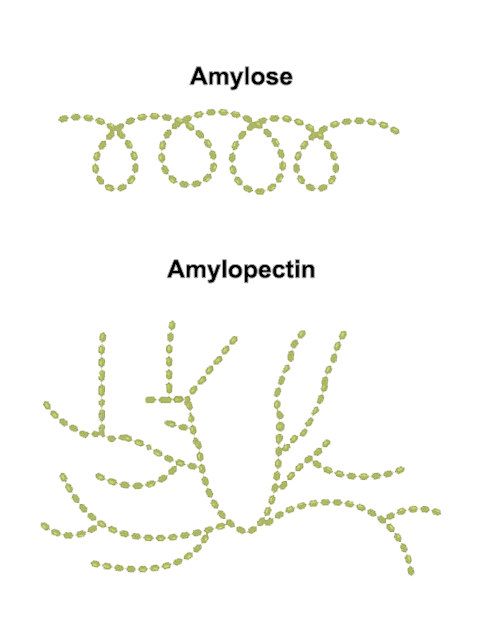
Amylose and amylopectin are the two primary forms of starch found in rice, and their ratio is the main factor that determines how rice behaves during cooking.
Starch is a carbohydrate made of glucose chains. In rice, it appears in two structural forms that are Amylose and Amylopectin.
Amylose is a mostly linear molecule. It packs tightly, absorbs less water, and tends to produce firmer, more separated grains that hold structure as they cool.
Amylopectin is highly branched. It swells easily with heat and water, creating viscosity and stickiness, and driving cohesion between grains.
The ratio between the two determines texture: high amylose leads to dry, distinct grains (e.g. basmati), while high amylopectin leads to sticky or creamy textures (e.g. sushi or glutinous rice). In practice, this balance defines whether rice behaves as separated grains, a cohesive mass, or a creamy matrix.
Emulsification Systems (Arborio & Carnaroli)
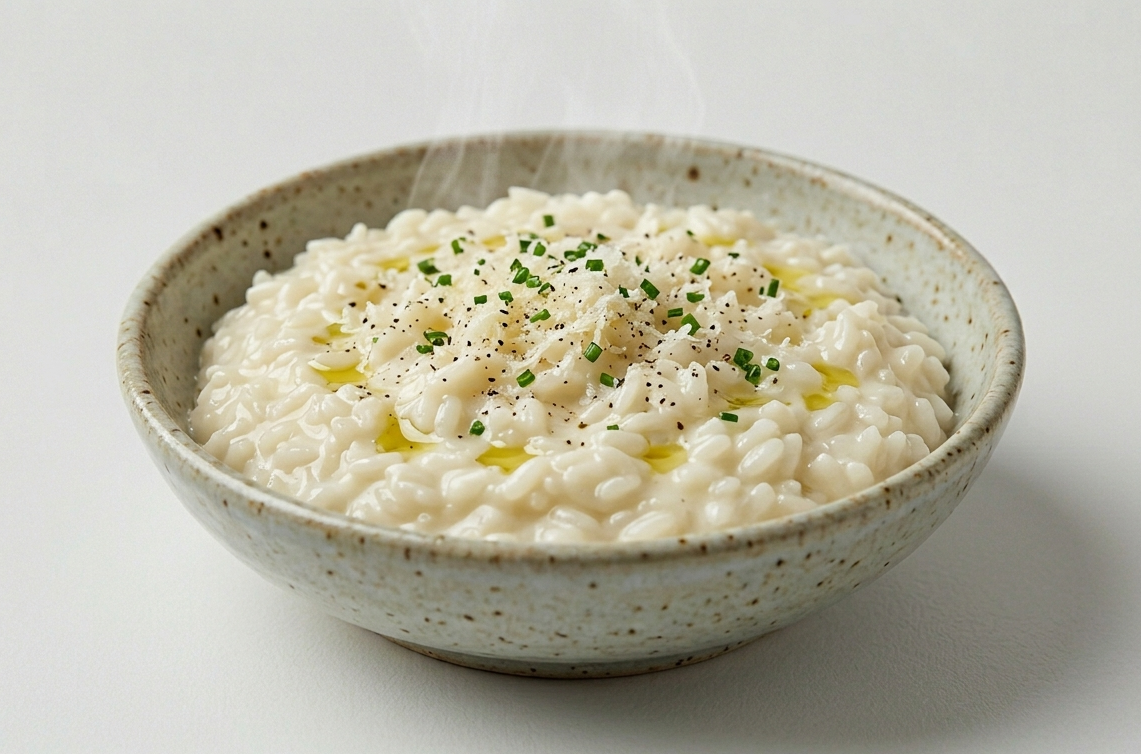
Italian short to medium-grain rices are designed for starch release and emulsion formation.
While these two rices sit within the same functional category of Italian risotto rices, they behave differently under thermal and mechanical stress due to their internal starch structure and grain morphology.
Arborio
Arborio is characterized by a large, rounded grain with a relatively exposed starch surface. This makes it highly reactive during cooking: it releases starch quickly, producing a creamy and cohesive matrix. However, this same property comes with limited structural control. The outer layers tend to soften rapidly, while the core lags behind, creating a narrower window of precision before the grain begins to lose definition. The result is a rice that is expressive in creaminess, but less forgiving in execution.
Starch profile: Amylose 17%, Amylopectin 83%
High starch release with moderate structural collapse → creamy, but less controlled emulsification.
Carnaroli
Carnaroli, by contrast, presents a slightly longer grain with a more resilient structure. Its starch release is still enough to generate the characteristic risotto emulsion, but it occurs in a more controlled and gradual manner. This balance between starch dispersion and structural integrity gives it greater stability during cooking. It is more tolerant to timing variations and heat fluctuations, which is why it is often preferred in professional kitchens.
Starch profile: Amylose 25%, Amylopectin 75%
Higher amylose improves grain integrity during cooking → better stability and controlled cream formation.
Functional identity
These rices are built for risotto: continuous stirring, gradual liquid incorporation, and controlled starch extraction. The result is not separate grains but a cohesive, flowing emulsion (“all’onda”).
The preferred cooking technique is risottatura: a gradual incorporation of water until all the starchy granules have been released into an even texture.
Separation Systems (Jasmine & Basmati)
These long-grain aromatic rices operate on a fundamentally different principle compared to starch-rich Italian varieties. Their primary function is not emulsification or structural binding, but rather grain separation combined with volatile aroma release. The cooking goal is to preserve the individuality of each grain while allowing aromatic compounds to diffuse into the surrounding matrix without collapse.
Jasmine (Thailand)
Jasmine rice, originating from Thailand, is defined by a soft, slightly sticky texture that emerges from moderate amylopectin presence. Its grains retain a light cohesion when properly cooked, avoiding clumping while still adhering gently to one another. What distinguishes it most is its aromatic profile: a naturally occurring floral note derived from specific volatile compounds, which becomes more pronounced during steaming. The result is a rice that feels soft and cohesive, but never structured into a creamy mass.
Starch profile: Amylose 15%, Amylopectin 85%
Low-to-medium amylose → soft cohesion, slight stickiness, floral aroma release.
Basmati (India/Pakistan)
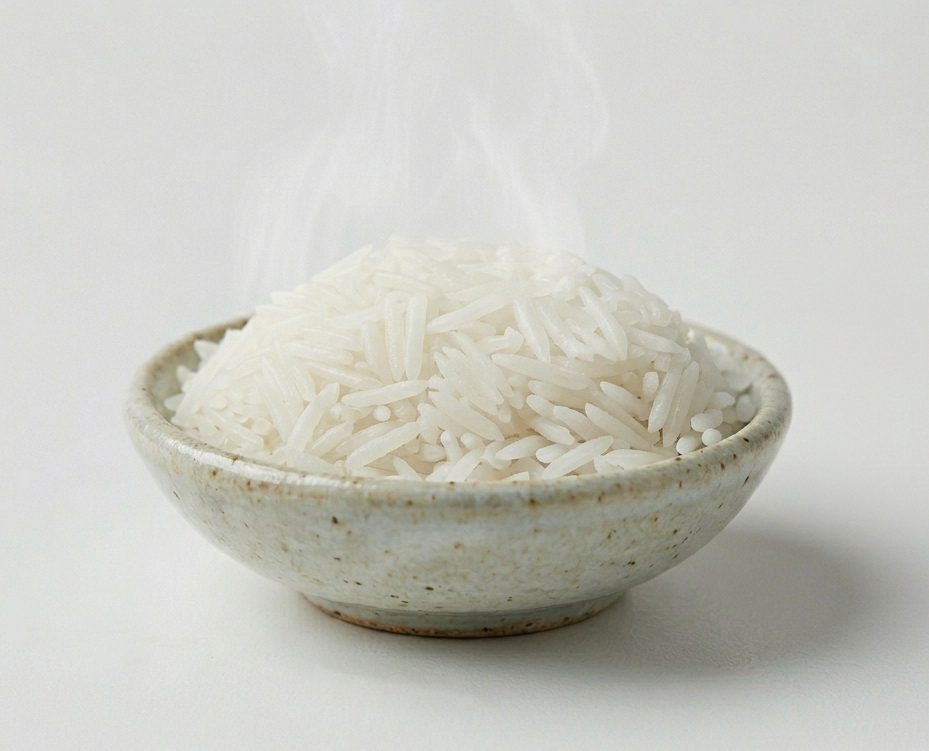
Basmati rice, by contrast, is structurally drier and more rigid in separation. The grains are long and slender, designed to remain discrete after cooking, with minimal surface starch adhesion. Its aromatic profile is more restrained and nutty rather than floral, developing through aging and dehydration processes rather than fresh volatility. When cooked correctly, basmati produces a clearly delineated grain structure, where each unit remains independent, functioning as a neutral carrier for sauces and reductions rather than integrating into them.
Starch profile: Amylose 25%, Amylopectin 75%
High amylose → dry, separated grains with minimal surface adhesion.
Functional identity
These rices are designed for absorption without binding. They act as carriers for sauces, gravies, and oils rather than integrating into them. Each grain remains individually defined.
The preferred cooking technique is steaming, ideally with a rice cooker. Steaming allows the water to evaporate slowly while the rice softens without losing its aromas or structural integrity.
These characteristics make these rices ideal candidates for dishes where rice is meant as a supporting or complementary element.
Cohesion Systems (Sushi & Glutinous)
Sushi rice and glutinous rice (also known as Sticky rice) sit on the same general axis of cohesion-driven grains, but they diverge in terms of structural integrity and post-cooking behavior. The distinction is not simply one of stickiness, but of whether grain identity is preserved or fully dissolved into a continuous matrix.
Sushi rice (Japan)
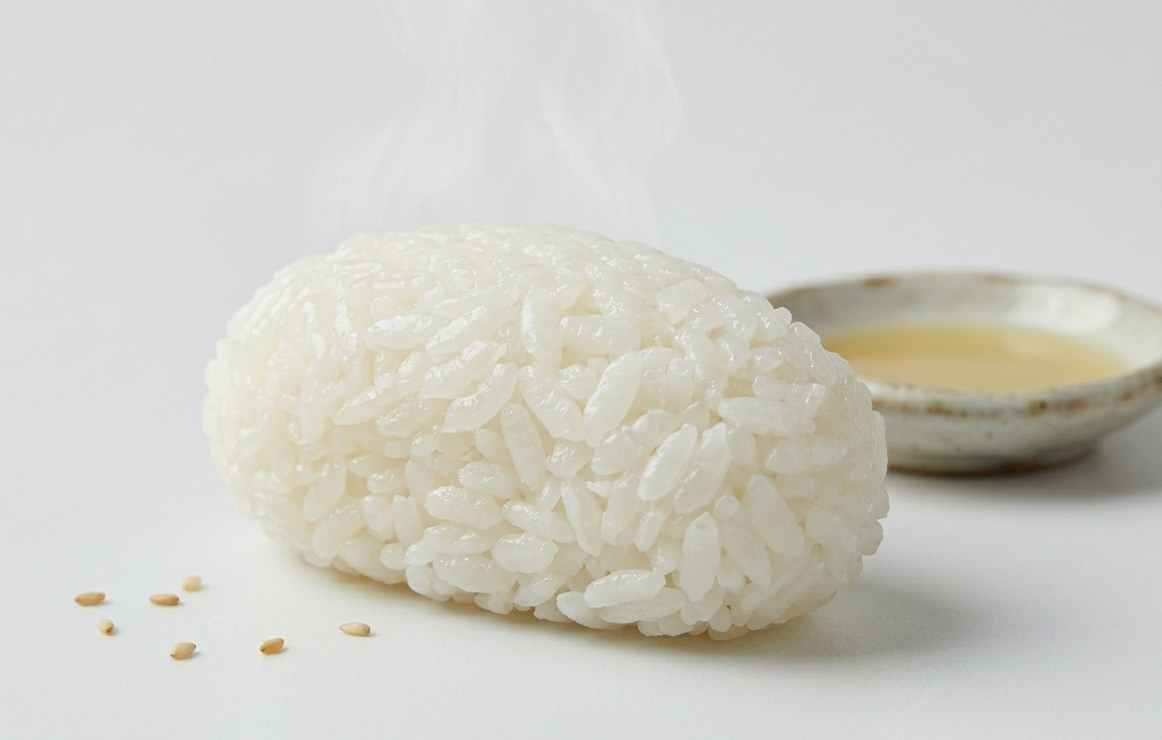
Sushi rice operates on the principle of cohesion without loss of structure. It is short-grain rice with a controlled level of surface starch, which becomes adhesive after cooking but does not erase the individuality of each grain. The grains remain perceptible, yet bind together into a malleable mass. This behavior is further stabilized through seasoning with vinegar, sugar, and salt, which modifies both texture and handling properties.
Starch profile: Amylose 20%, Amylopectin 80%
Balanced toward adhesion → cohesive but structurally intact grains.
Its functional profile is therefore tied to shape retention under pressure: it can be compressed, molded, and cut, while still preserving an internal granular architecture. Unlike risotto rice, it does not dissolve into a creamy emulsion. Instead, it forms a malleable, structured mass that can be shaped into nigiri, rolls, or bowls without collapsing.
The preferred cooking technique is steaming, ideally with a rice cooker.
Glutinous rice
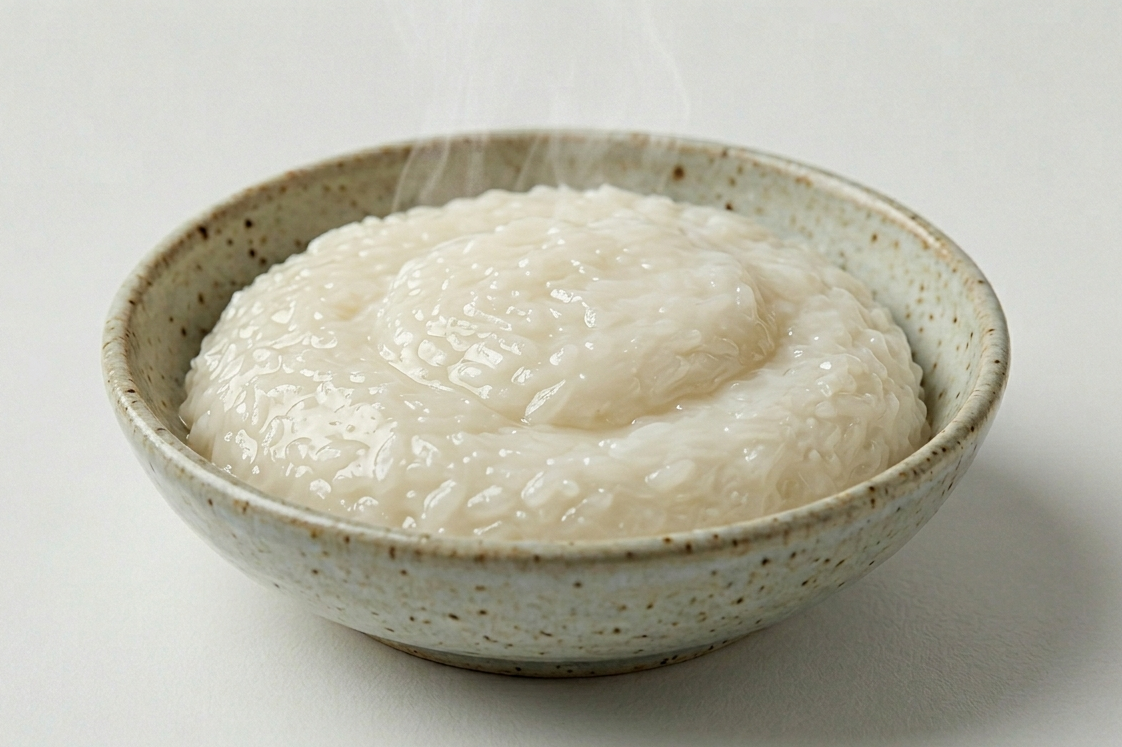
This type of rice, cultivated all across South East Asia, represents the extreme end of cohesion where grain identity is effectively lost. Its starch composition is almost entirely amylopectin-dominant, leading to an intense adhesive behavior during steaming. The result is not a collection of grains bound together, but a unified, elastic mass in which individual units are no longer distinguishable. It does not flow or emulsify; instead, it compacts into a dense, moldable structure.
Starch profile: Amylose 2%, Amylopectin 98%
Almost complete absence of amylose → full gelatinisation into a unified, elastic mass.
Its functional profile is represented by a deformable material rather than a particulate grain system, used where compression, shaping, or direct manual forming is required rather than granular definition.
It is no coincidence that dishes such as the popular Thai dessert mango sticky rice use glutinous rice as their base. Its texture develops into a dense, cohesive mass reminiscent of a cream-like pudding, intended to be eaten with a spoon.
The preferred cooking technique is steaming, ideally with a rice cooker.
Whole-grain (Integral) Rices
These rices retain the bran and germ layers, meaning they are minimally processed. The result is a shift away from starch-driven behavior toward fiber structure, chew, and aromatic density.
They do not primarily function through emulsification or cohesion systems, but through texture and resistance.
Starch profile: Amylose 20%, Amylopectin 80%
Bran layer significantly reduces effective starch release and gelatinisation speed.
Black rice (Venere)
Black rice (Venere) is an Italian pigmented whole grain rice characterized by its dark purple-black color due to anthocyanins in the bran layer. It develops a firm, slightly chewy texture after cooking, with a toasted, nutty aroma and a dry, grain-forward structure.
Red rice
Red rice retains its outer bran layer, which contains pigment compounds responsible for its reddish-brown hue. It has a firm bite and an earthy, nutty flavor, with a slow cooking response due to its intact structure.
Functional identity
Whole-grain rices present as structural, with high textural integrity. This type of rice does not emulsify or bind; instead, it introduces contrast, chew, and visual intensity. Typically used as a base for compositions requiring separation and sharp flavour counterpoints.
The preferred cooking technique is boiling in hot water, preferably pre-soaking (30-60 min) to reduce cooking time.
Conclusive perspective
Rice is not interchangeable. It is a functional design choice that determines texture, structure, and the way a dish behaves under heat, liquid, and time. But more precisely, it is not a single ingredient category—it is a spectrum of starch architectures and physical responses.
Across varieties, what changes is not only flavour or grain size, but the underlying starch profile: the ratio between amylose and amylopectin, and how this ratio is constrained or amplified by the presence of the bran layer. From risotto rices that collapse into controlled emulsions to long-grain aromatics that preserve separation, to sushi rice that forms structured cohesion, and finally to glutinous rice that loses grain identity entirely, each system defines a different mode of aggregation.
On the other end of the spectrum, integral rices such as venere, red, and wild rice reduce starch behaviour altogether, shifting the focus from binding to resistance—where structure persists rather than transforms, and chew becomes the primary variable instead of cream or cohesion.
Seen through this lens, rice is not a side element supporting a sauce, but the regulating mechanism of the entire composition: it dictates whether a dish flows, separates, binds, or holds form. Understanding rice is therefore not a matter of recipe execution, but of controlling how matter organizes itself under transformation.
Bibliography
This article is the result of a synthesis and reinterpretation of established concepts in food chemistry and culinary science. The framework presented—particularly the relationship between starch composition (amylose/amylopectin) and cooking behavior—can be found in large part in the following sources:
Harold McGee — On Food and Cooking: The Science and Lore of the Kitchen
Belitz, Grosch, Schieberle — Food Chemistry
B. O. Juliano — Rice Chemistry and Technology