
Modern Carbonara
One of the most debated italian pasta dishes on social media, often pushed toward unnecessary refinement. My version takes a measured approach instead: technique, balance, and a few deliberate deviations from an “original” recipe that is, by now, more myth than standard.
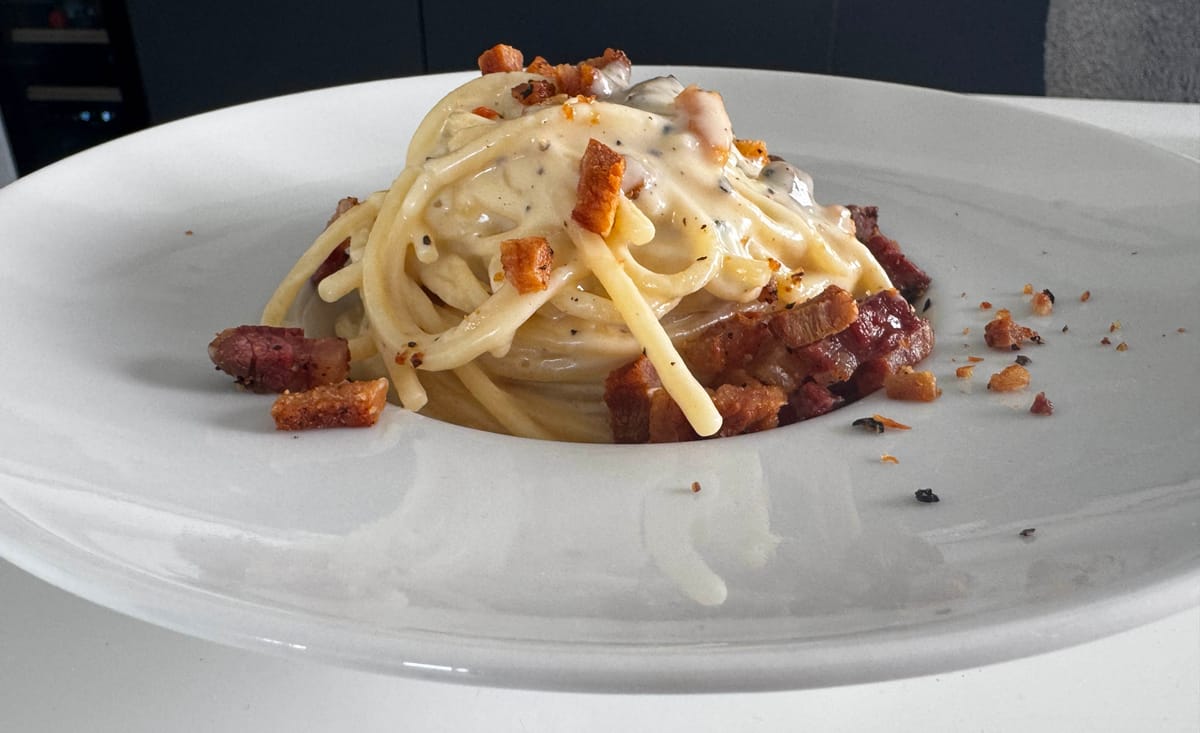
Ingredients (for 4 people)
- 4 eggs
- 200 g Parmigiano Reggiano
- 200 g Pecorino Romano
- 250 g guanciale
- 400 g spaghetti
- black pepper (freshly ground)
- Salt
Preparations
Egg and Cheese Base
- Combine the egg yolks (only one per serving) with the finely grated Parmigiano and Pecorino in a bowl. Add a generous amount of black pepper and mix until a dense, semi-solid paste forms.
The consistency can be adjusted by varying the proportion of Parmigiano and Pecorino. The correct texture is reached when the mixture no longer sticks to the fingers when touched.
Cooking
- Cut the guanciale into medium strips and render it slowly over medium heat in a large pan. The pan must later accommodate the pasta and the sauce.
- Cook the spaghetti in lightly salted boiling water.
- Once the guanciale has turned golden brown and released a substantial amount of rendered fat, remove the crispy pieces and let them rest on absorbent paper for about 5 minutes.
- When the pasta reaches roughly half of its cooking time, begin the risottatura. Add one ladle of pasta water to the rendered guanciale fat and raise the heat.
- Transfer the pasta directly into the pan, keeping the remaining pasta water hot.
- Continue cooking the pasta in the pan, gradually adding pasta water while stirring continuously. The starch released by the pasta should emulsify with the guanciale fat, progressively forming a dense and cohesive sauce.
- Once the pasta is cooked, turn off the heat and allow part of the residual heat to dissipate before adding the egg and cheese mixture to the pan.
- Mix rapidly so the paste melts evenly into the sauce and coats the pasta without solidifying.
🖋️
A proper carbonara is fundamentally based on risottatura rather than simple draining and mixing.
For this reason, pasta selection matters. High-quality bronze-die pasta with strong starch release produces a more stable and cohesive emulsion.
For this reason, pasta selection matters. High-quality bronze-die pasta with strong starch release produces a more stable and cohesive emulsion.
❗
Residual heat alone must bind the egg mixture to the sauce already present in the pan. Additional heat at this stage will easily cause the eggs to coagulate and separate.
This is the most common failure point of the dish and usually results from excessive pan temperature or slow mixing.
This is the most common failure point of the dish and usually results from excessive pan temperature or slow mixing.
Plating
Shape the pasta into a nest and finish with the crispy guanciale, either cubed, crushed into coarse crumbs, or left in strips.