The Art of the Cut: Know your blades...from West to East
This second post dedicated to blades explores the mechanical divide between Western and Eastern cutlery. It breaks down geometries and shapes so you can choose the exact knife every ingredient demands, elevating both your technique and your results on the board.

This is the second and biggest installment of this 4-post series "The Art of the Cut", where I share a deep-dive with all the knowledge that I acquired in the world of kitchen knives. You can trace back to the previous post with the link below.
 Luca Mennoia
Now let's start with a premise. I won't lie! This topic is quite an obsession for me, so I find it hard to treat it succinctly. It's going to be quite a long read.
I'm going to do my best to be concise, but I can make no promise. What I do promise is that you won't get bored!
Context: from Solingen to Seki
A blade is never just a piece of steel. It is the product of centuries of tradition, discipline, and relentless evolution. Every angle, curve, and choice of metal exists for a reason; shaped by historical necessity and refined over generations into the tool we rely on today.
This is why I think that learning some history is the best way to choose a blade that truly aligns with your needs, and personal style.
While notable cutlery traditions exist worldwide (e.g., chinese Caidao, turkish butcher knives, serbian chef knife, etc.), today's global market is divided into two dominant schools: the Western tradition and the Eastern tradition. This duality is rooted in history, geography, and diet, represented by two historical metalworking capitals:
- Solingen (Germany) is known for centuries as Western Europe’s "City of Blades" where the classic Western workhorse was pioneered. Built on centuries of heavy agricultural butchery, German knifemaking favored thick spines, softer and ductile stainless steels, and robust edges designed to withstand heavy compression without chipping.
- Seki (Japan): The historic capital of samurai katana smithing. When traditional sword-carrying was banned in the late 19th century, master blacksmiths pivoted their metalworking genius toward the kitchen, giving rise to razor-thin, ultra-hard high-carbon blades engineered for effortless, surgical precision.
My cooking style resonates with precision and cleanliness, and this makes me a big fan of the Japanese school.
Nevertheless, neither philosophy is superior to the other: each solves a different culinary problem.
Recognizing this divide is the first real step in choosing (and respecting) the right tool for your cutting board.
Hardness vs. Ductility
When choosing a knife, the single most critical starting point is understanding two defining mechanical properties of its steel.
- Hardness: Harder steel resists microscopic deformation, meaning the cutting edge stays razor-sharp for much longer under sliding abrasion. This quality makes the same steel inherently brittle with low tolerance to high-energy impacts.
- Ductility: can measure the ability to absorb energy before fracturing. Softer steels are more ductile and flex under lateral stress or high impact, preventing chips when the blade hits tough or dense obstacles on the board.
Single Bevel vs. Double Bevel Knives
The geometry of a blade’s cross section is another fundamental metric used to classify cutlery and distinguish specific knife types. Beyond steel hardness or overall profile, how the blade tapers from spine to edge determines how it interacts with food.
Commercial kitchen cutlery falls into two main classes:
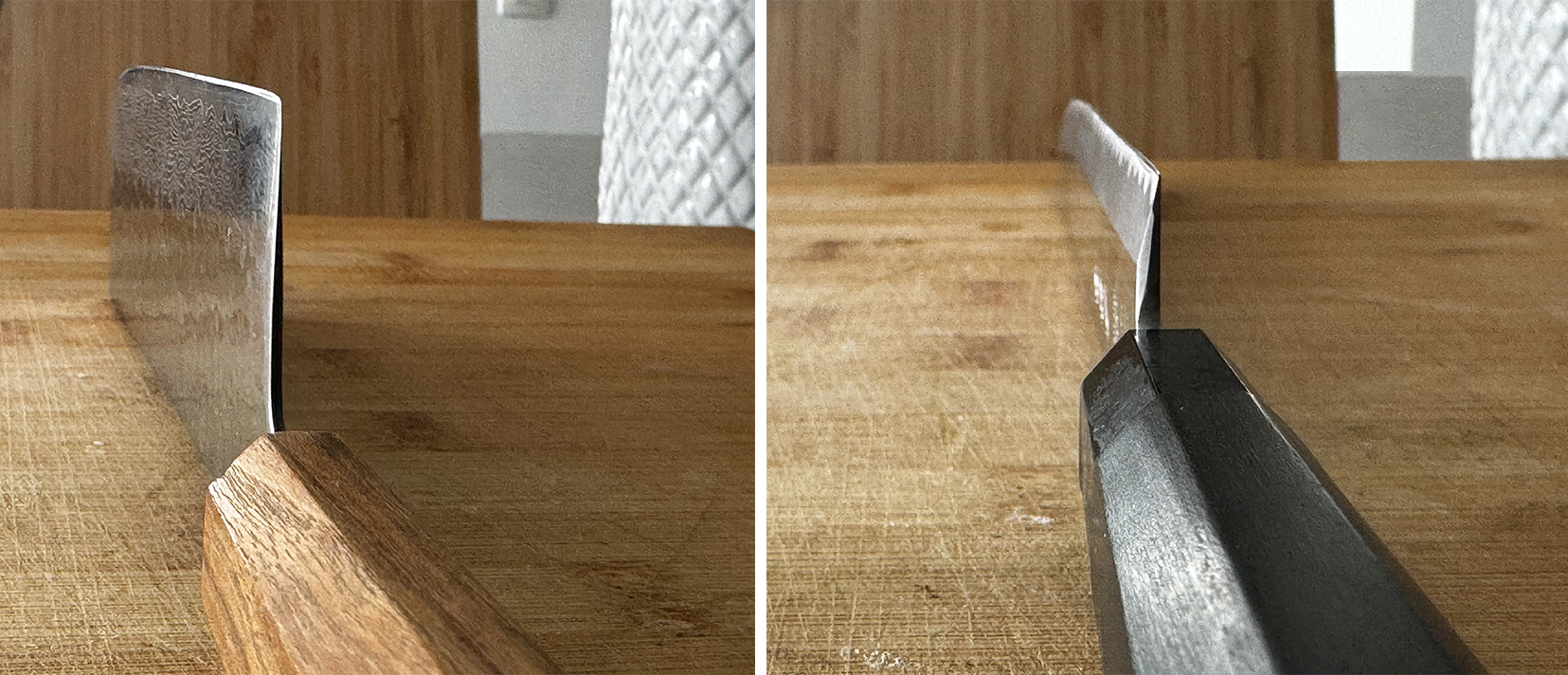
- Double-Bevel Knives: Symmetrical blades ground on both sides. They are the universal standard for all Western style knives and modern Japanese knives; engineered for intuitive and straight cuts, easy to use and to sharpen.
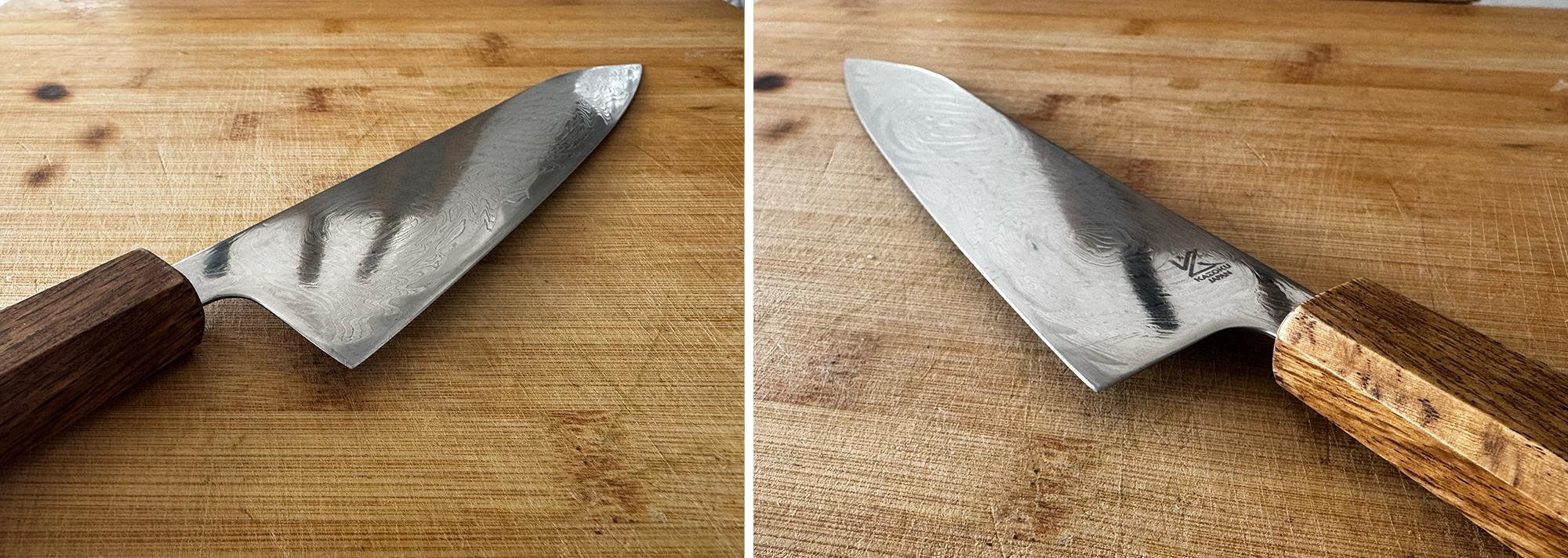
- Single-Bevel Knives: Asymmetrical blades ground exclusively on one side, paired with a hollow-ground back face. Widely adopted for traditional Japanese blades, these highly specialized tools prioritize razor-like precision, clean tissue separation, and directional control. These blades demand a higher level of cutting technique and a thorough understanding of their geometry to sharpen properly without permanently damaging the blade profile.
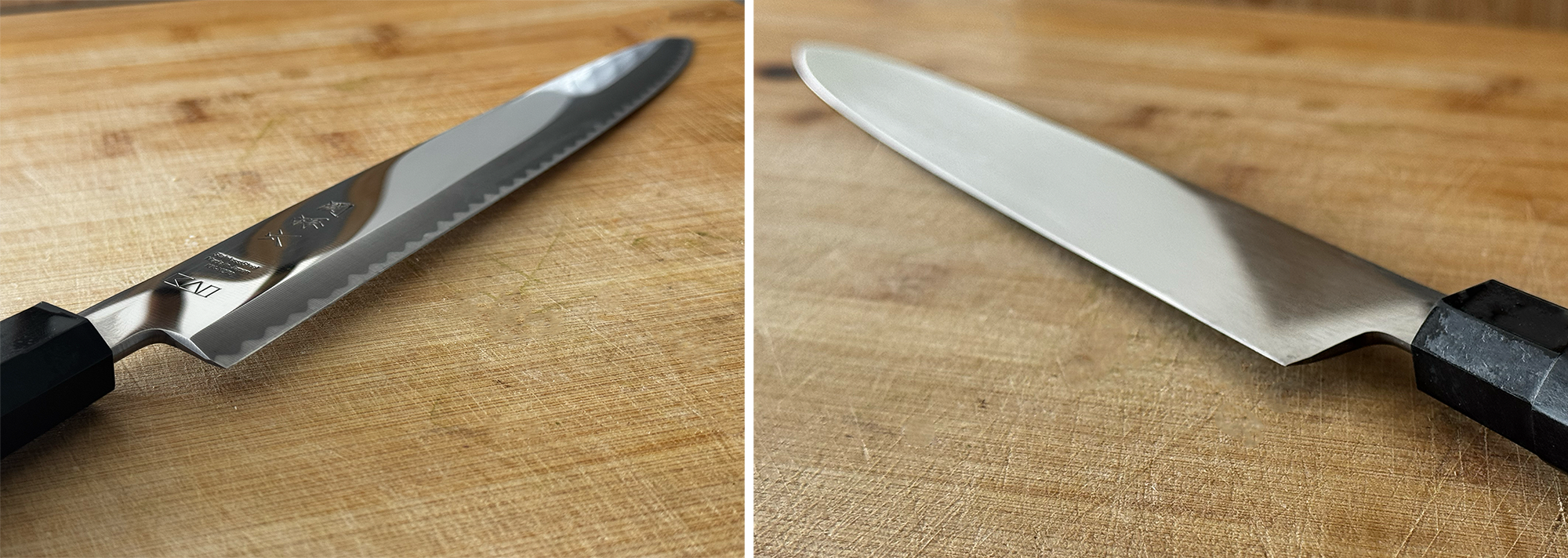
To understand how both types function, we must break down the key zones of their cross-sectional profile:
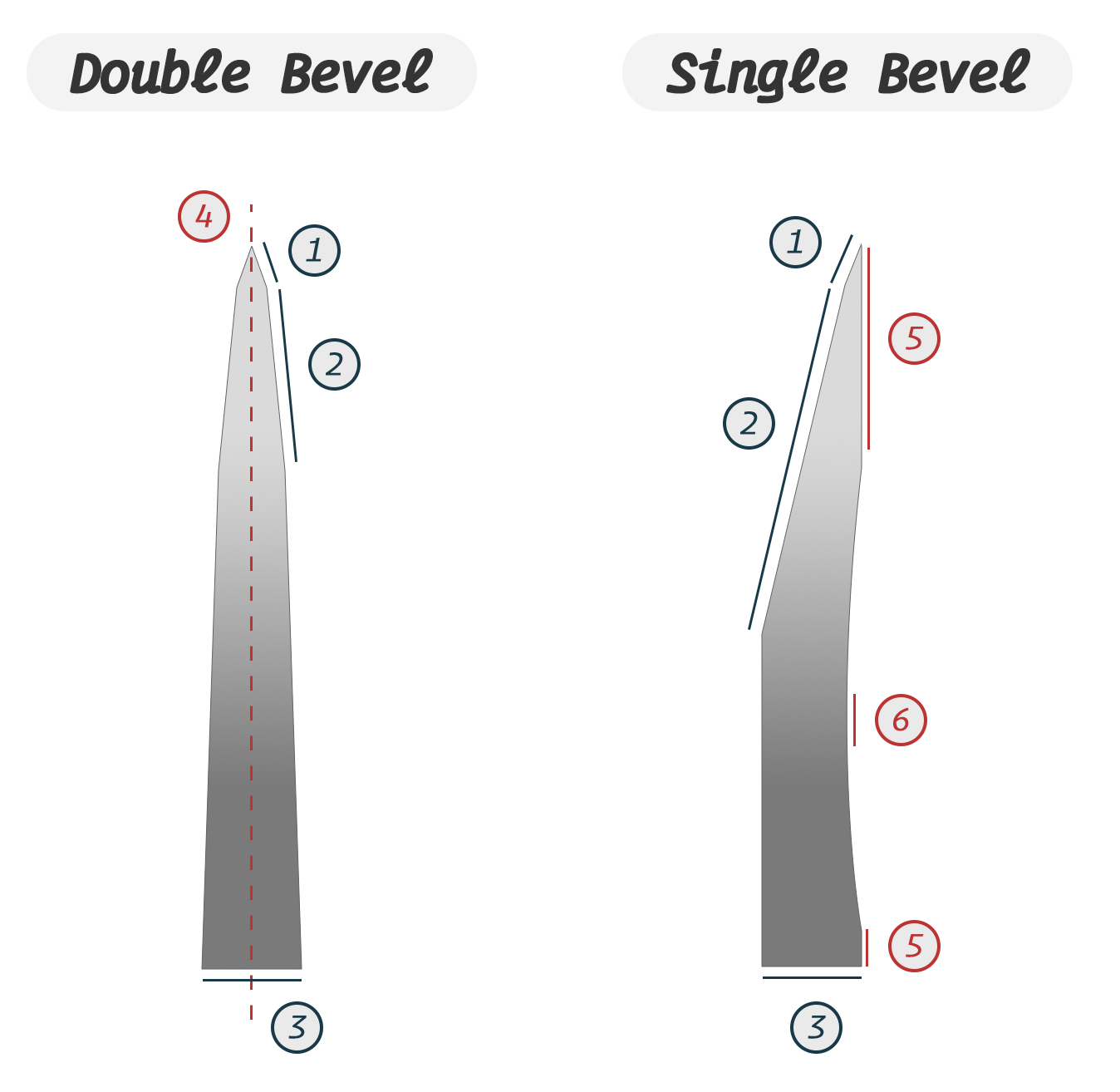
- 1. Micro-bevel (刃先 Hasaki): the microscopic edge angle that makes direct contact with food cells, determining the initial sharp split and bite.
- 2. Primary Grind (切刃 Kireba): often also referred to as the "blade road", it is the macro-taper running down the face of the blade, responsible for food release and wedging resistance.
- 3. Spine Thickness (棟 Mune): the cross-sectional width at the back of the blade, providing structural backbone, weight, and lateral stiffness.
- 4. Centerline: the central axis of symmetry in double-bevel knives that balances resistance on both sides to keep cuts straight.
- 5. Flat Back (裏押し Uraoshi): the flat perimeter on the back face of a single-bevel blade that allows it to ride flush against ingredients and guides the direction of the cut.
- 6. Hollow Grind (裏すき Urasuki): the hollow relief forged into the back of a single-bevel knife to eliminate suction, preventing delicate food from sticking. This feature reduces surface drag to glide through food cells cleanly without crushing or tearing.
A double-bevel knife works by pushing laterally both the left and right wall around the split line. A single-bevel knife pushes away only the wall in contact with the Kireba, while the other gently slides up the Uraoshi.
Knife Types
Every kitchen knife reflects its regional heritage — a deliberate trade-off between durability and precision. Western cutlery relies on softer, ductile steel and symmetrical double-bevel geometries to handle punishing, multi-purpose tasks without chipping. Traditional Japanese knifemaking prioritizes extreme steel hardness, acute angles, and specialized single-bevel profiles designed to cleanly glide through ingredients with minimal cell damage.
This section breaks down 5 structural categories shaped by these opposing philosophies. The first category covers the western school, whereas the remaining four provide an extensive coverage of the Japanese craftsmanship:
- Western Knives: Heavy, full-tang workhorses built with resilient steel for high-impact chopping and full-hand power grips.
- Modern Japanese Knives: Double-bevel hybrid profiles (Gyuto, Santoku, Bunka) that bring Japanese steel hardness to versatile, everyday prep.
- Traditional Japanese Knives: Classic single-bevel blades (Yanagiba, Deba, Usuba) tailored strictly to specific, technique-heavy raw protein and vegetable cuts.
- Kiritsuke / Sakimaru Variants: Sword-inspired tip geometries engineered to add surgical scoring and long-stroke pulling capability to standard profiles.
- Japanese Task-Specific Knives: Special category of rare knives used solely for very specific preparations and tasks, treated for completeness.
Western Knives
Western blades prioritize ductility over maximum hardness: this lower hardness makes the steel malleable and forgiving. When the edge hits a tough obstacle or experiences lateral twisting, the metal rolls slightly rather than chipping. This micro-flexibility makes Western knives very durable and capable of hacking through soft bones and hard rinds, while allowing quick edge restoration via a traditional honing steel.
Anatomy & Key Terminology
While visually simpler than their Japanese counterparts, Western knives feature a complex anatomy, with each part studied for durability and powerful, multi-purpose use. This guide breaks down the technical necessary terminology to understand a western-style knife from point to pommel.
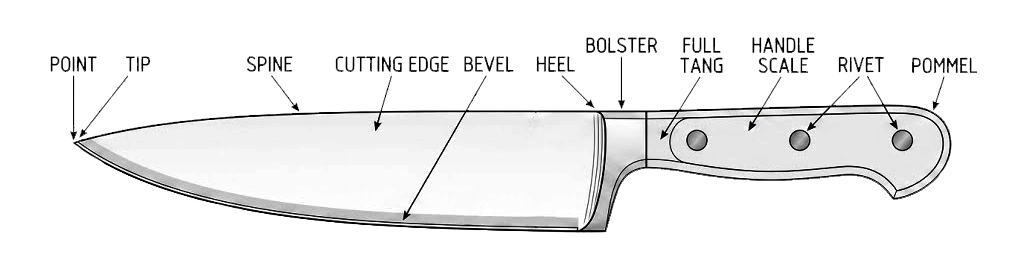
Key Terminology Explained
- Point: The extreme distal end of the knife, where the spine and cutting edge meet. It is the very first part that makes contact when piercing an object.
- Tip: The first third of the blade, including the point. The belly curve near the tip is often used for rocking cuts,specifically when chopping herbs.
- Spine: The thick, non-cutting top edge of the blade, opposite the cutting edge. The spine provides the blade with strength and weight, influencing balance.
- Cutting Edge: The honed, sharpened line running from the heel to the tip, which performs the actual cutting of food.
- Bevel: The sloping, sharpened surface that leads down to the final cutting edge, defining the edge geometry and sharpness.
- Heel: The rear section of the sharpened edge closest to the handle. This area sits where hand pressure is strongest, making it ideal for push cuts or heavier cutting tasks requiring leverage.
- Bolster: The thick band of metal located at the junction between the blade and the handle. It strengthens the knife, acts as a finger guard to prevent slipping, and balances the overall construction.
- Full Tang: A type of construction where the steel of the blade extends continuously the complete length and width of the handle, providing maximum durability and structural strength.
- Handle Scale: The two pieces of handle material (e.g., wood, composite, plastic) that flank the tang and are fastened together to form the grip.
- Rivet: One of the circular metal fasteners used to permanently secure the handle scales to the tang.
- Pommel: The end of the handle furthest from the blade, used for indexing and full-palm grips, and occasionally to provide balance.
Primary Blades
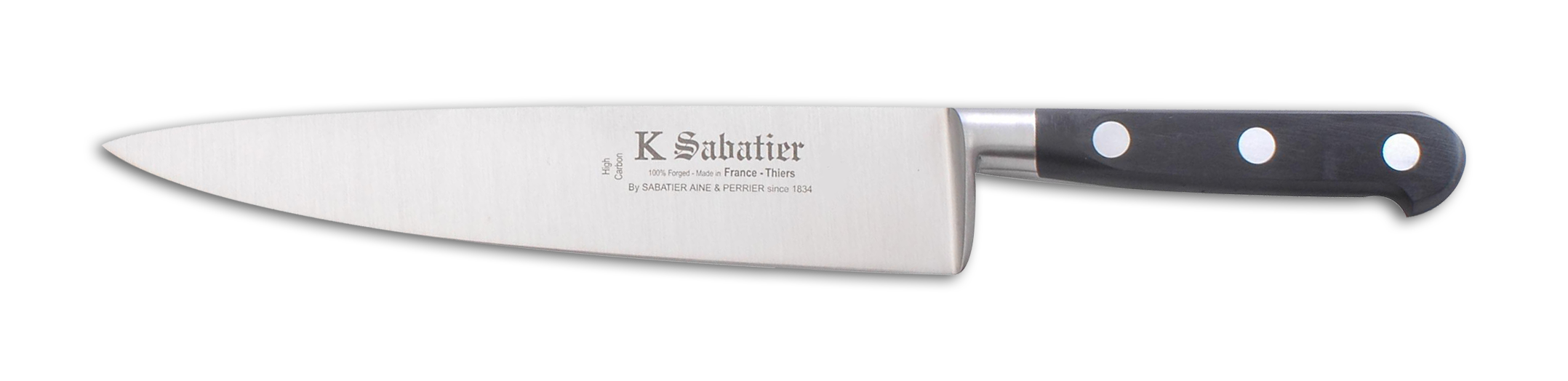
- French-Style Chef’s Knife (Sabatier): Features a flatter cutting edge profile with a gradual curve toward an acute tip. Optimized for straight push-cutting and long slicing strokes with minimal rock-chopping.
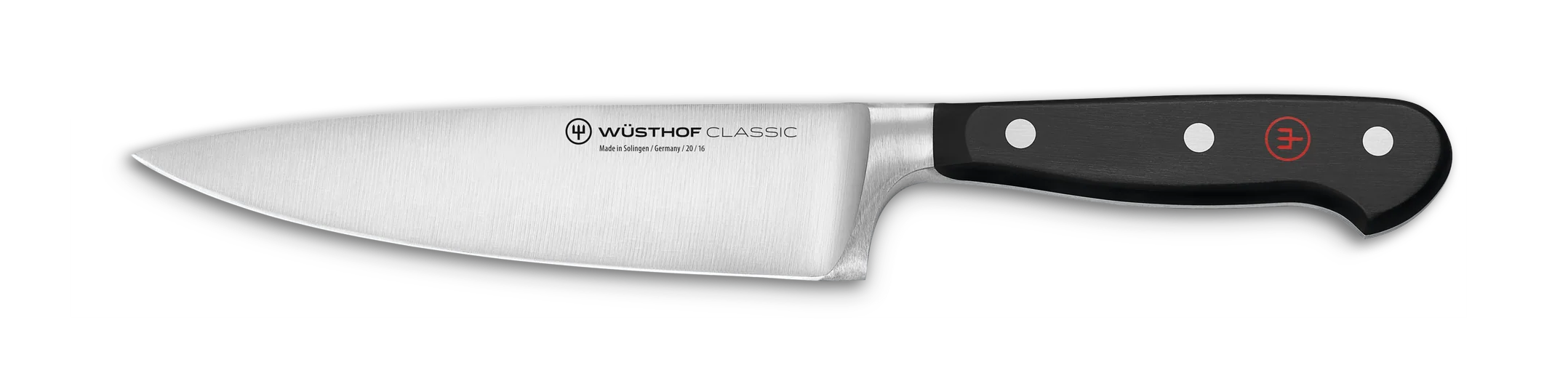
- German-Style Chef’s Knife (Wüsthof / Henckels): Defined by a pronounced, deep continuous curve ("belly"), a thicker spine, and a full bolster. Built specifically for a continuous rocking-motion cut keeping the tip grounded.
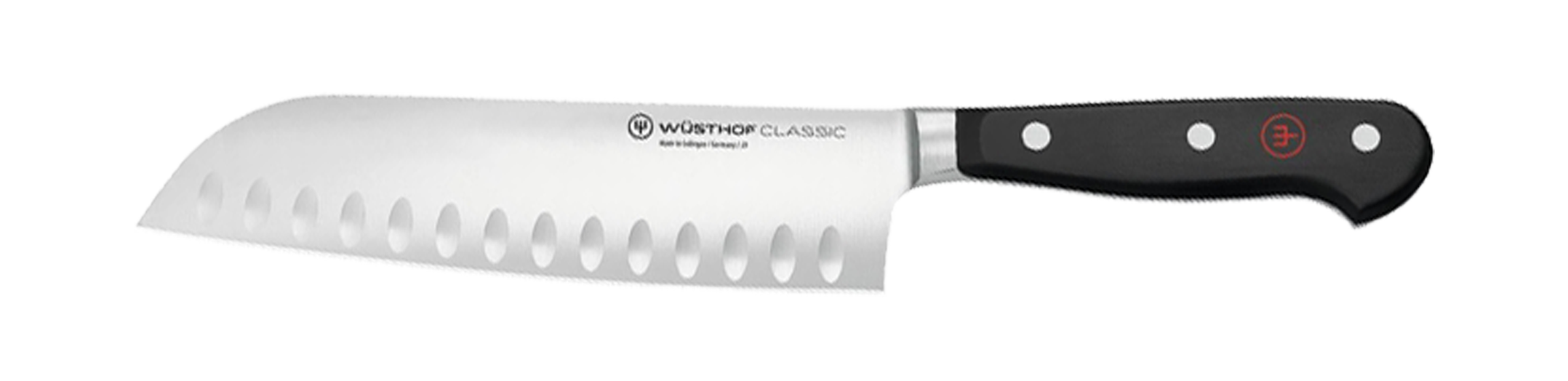
- Western Hybrid / Santoku: Almost always features fluted edge hollows and a slight belly curve added to a Japanese Santoku profile to accommodate Western rocking motions alongside push-chopping.
Precision & Utility Blades
- Classic Paring Knife (Spear Point): A short (8.5 – 10 cm), rigid double-bevel blade with a centered point. Used for off-the-board tasks like peeling, trimming, coring, and hand-held detail work.

- Tourné / Bird’s Beak Knife: Features a downward-curving sickle blade designed specifically for handheld spherical peeling and shaping vegetables into classic seven-sided French tourné barrels.

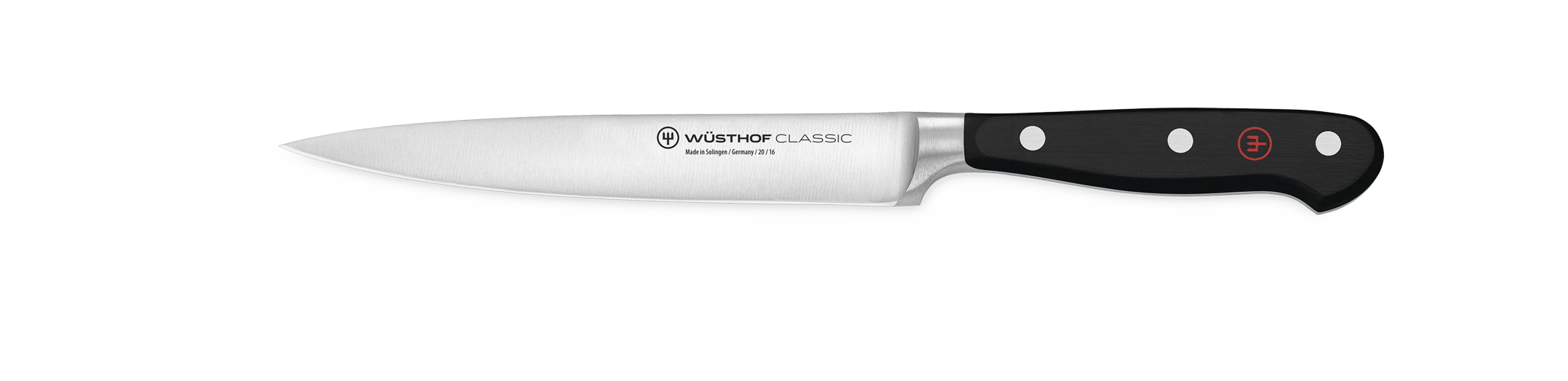
- Utility Knife: A mid-sized blade (12 - 16 cm) bridging the gap between a paring and chef's knife, used for mid-scale tasks like slicing citrus, soft cheeses, or small proteins.
- Bread Knife: A long blade (22 – 25 cm) with scalloped serrations designed to saw cleanly through hard artisanal bread crusts without crushing the soft crumb interior.
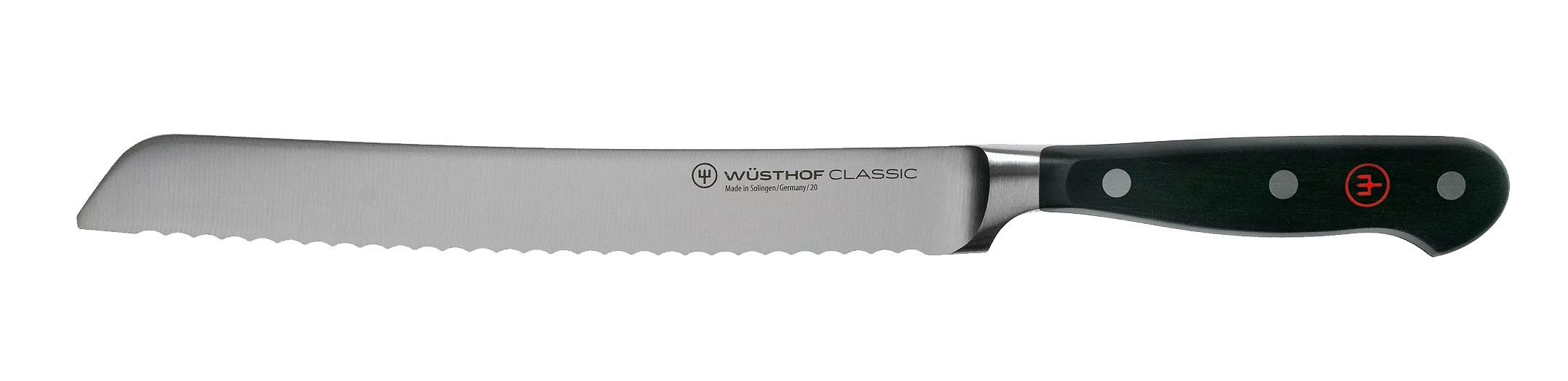
Slicing & Butchery Blades
- Carving / Slicing Knife: A long, narrow blade (20 – 30 cm) with a thin cross-section engineered to minimize surface drag when pulling clean, uniform slices off cooked roasts and hams.
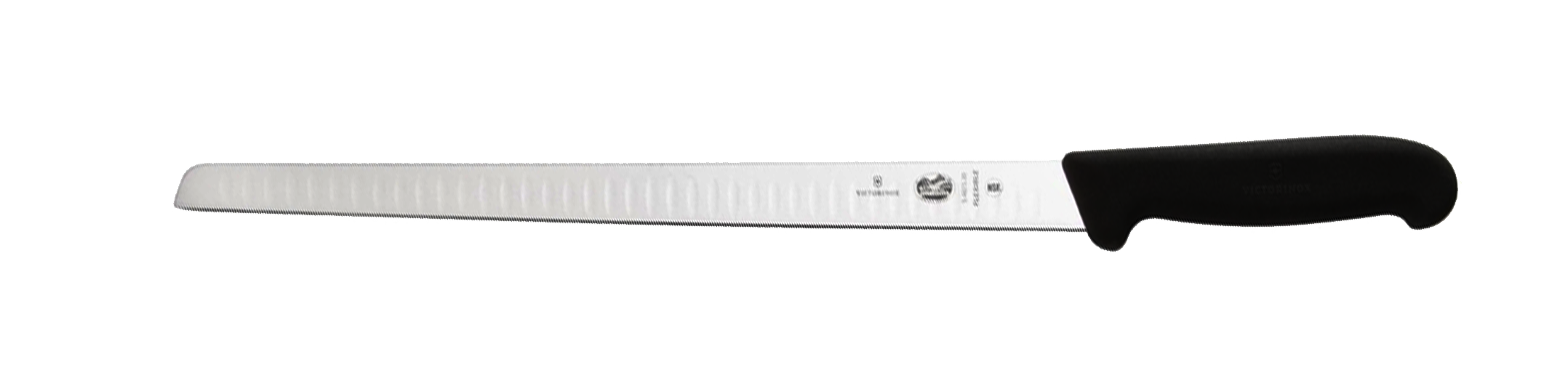
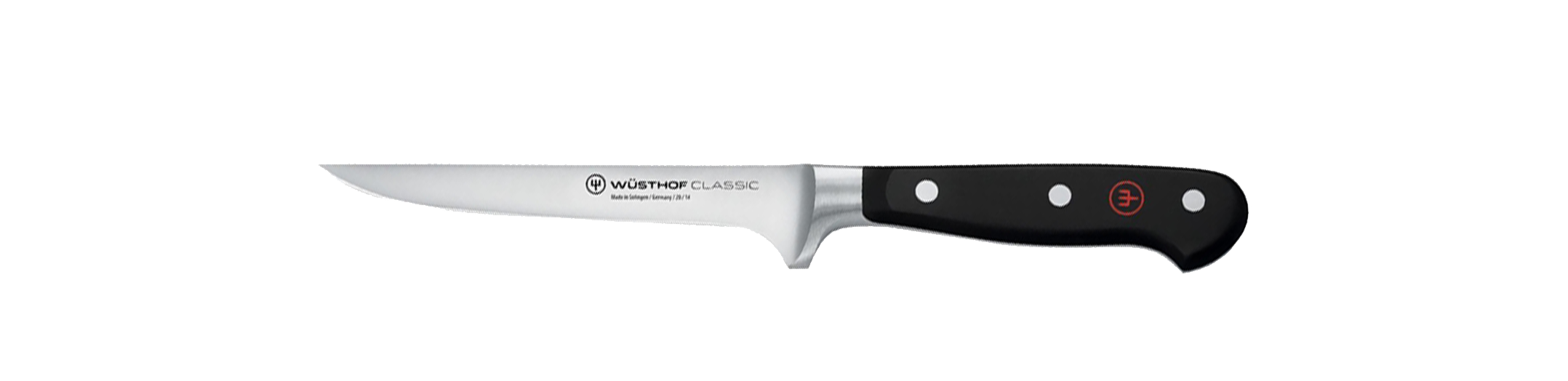
- Boning Knife (Flexible vs. Stiff): Features an upward-sweeping, narrow blade. Flexible variants trim fat caps and fillet fish/poultry; stiff variants work around dense beef and pork joints.
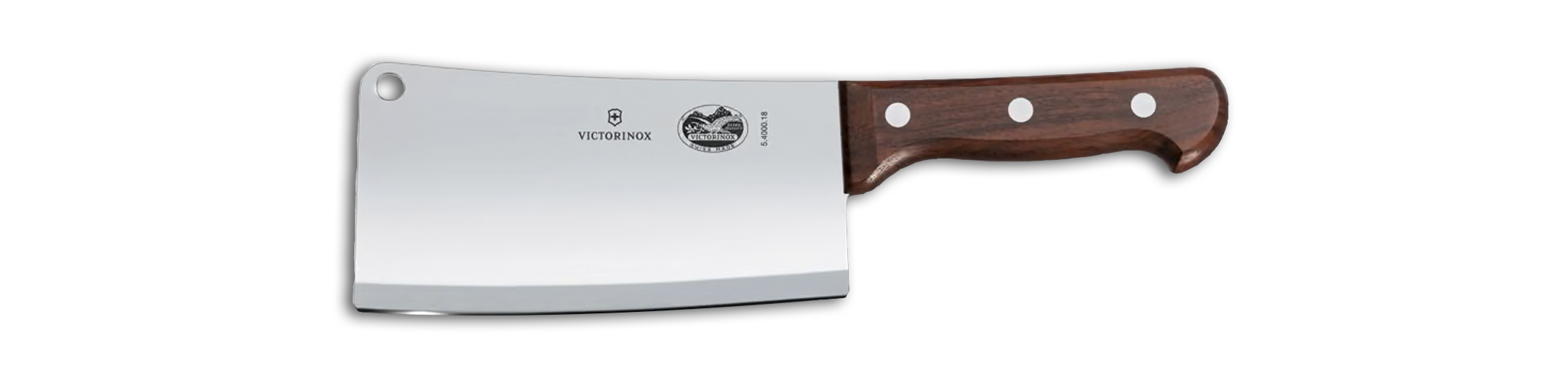
- Cleaver: A heavy, tall, thick-spined rectangular slab of steel with a durable, obtuse edge angle that uses mass and momentum to chop through bone, cartilage, and heavy joint tissue.
- Scimitar: A large, heavy, upward-curved butcher blade (25 – 35 cm) built for commercial processing—breaking down primal cuts and executing long sweeping cuts through heavy slabs of meat.
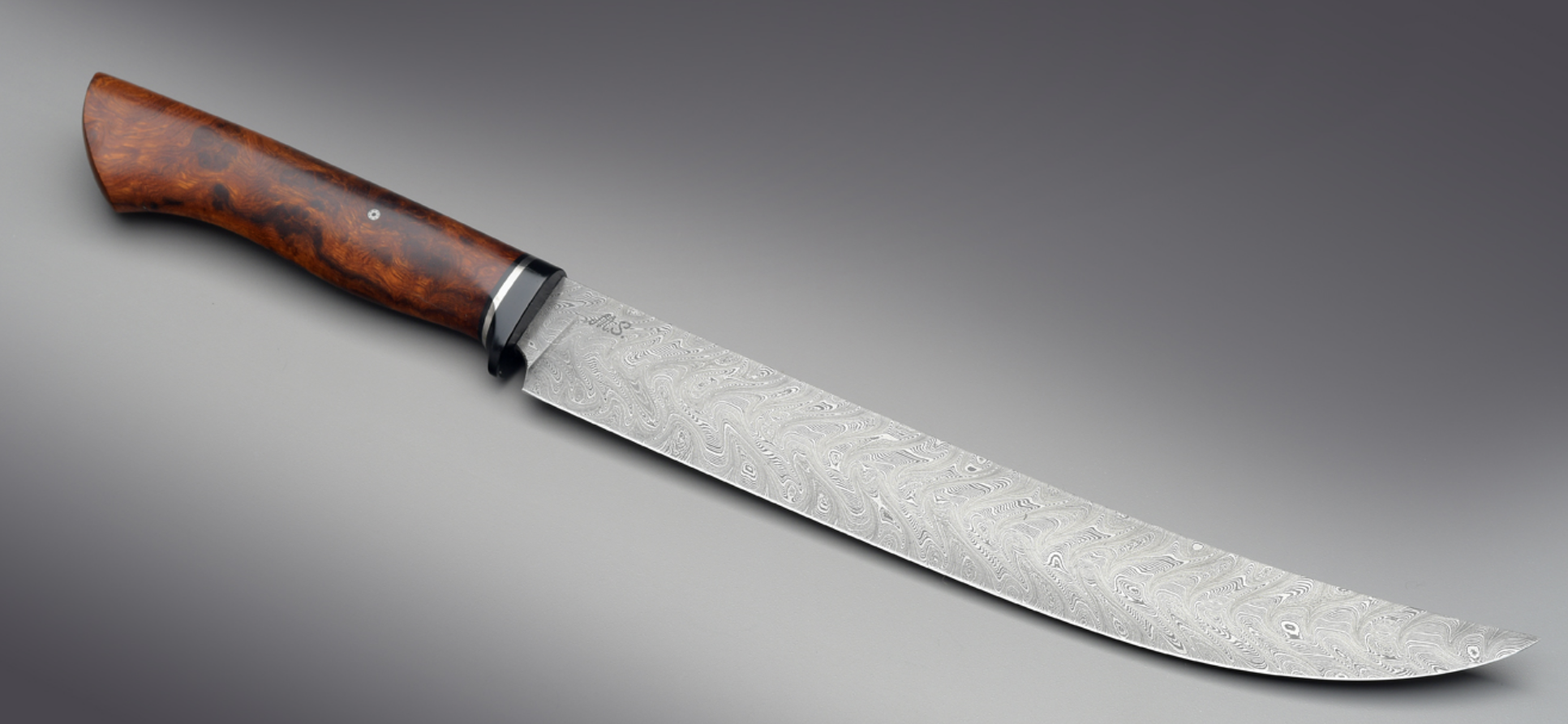
Modern Japanese Knives
Japanese cutlery trades ductility for extreme hardness. The rigid atomic structure holds a surgical, razor-thin edge at much lower bevel angles for effortless push-cuts. However, this lack of ductility renders the blade brittle; lateral twisting, impacting bones, or cutting frozen foods will cause the rigid steel edge to micro-chip or snap rather than flex.
Here follows a comprehensive list of the most important contemporary Japanese blades designed for high versatility, combining traditional Japanese precision and thin geometry with modern double-bevel edges for easy everyday use.
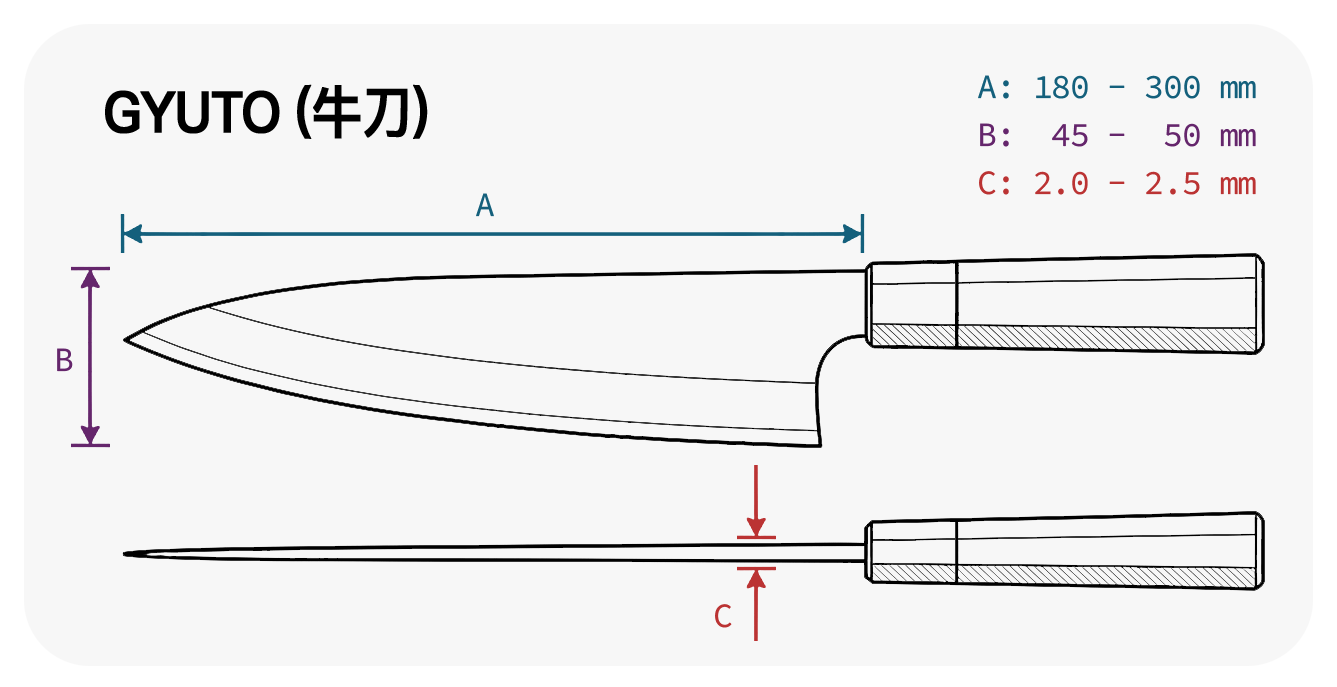
More about Gyuto
Gyuto literally means "beef sword." It is the Japanese adaptation of the Western chef’s knife, featuring a tall heel, long profile, and double-bevel grind (50/50).
It is designed as a primary workhorse for all-round kitchen prep—slicing meat, chopping vegetables, and prepping fish—offering continuous rocking motion and long slicing strokes.
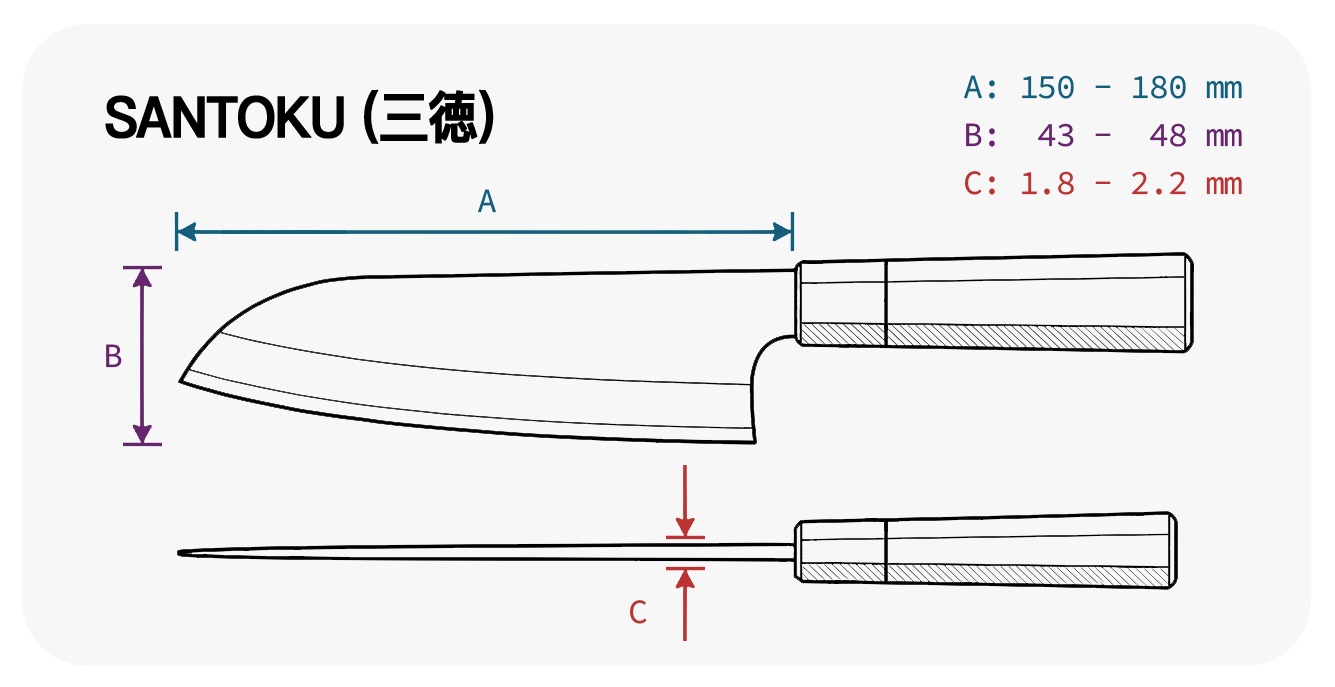
More about Santoku
Santoku means "three virtues" (referring to meat, fish, and vegetables), this double-bevel knife features a broad blade with a slightly rounded spine drop (sheep's foot tip).
This knife was created after WWII as a space-saving, highly versatile home kitchen knife for push-chopping and rapid board prep without needing a long blade.
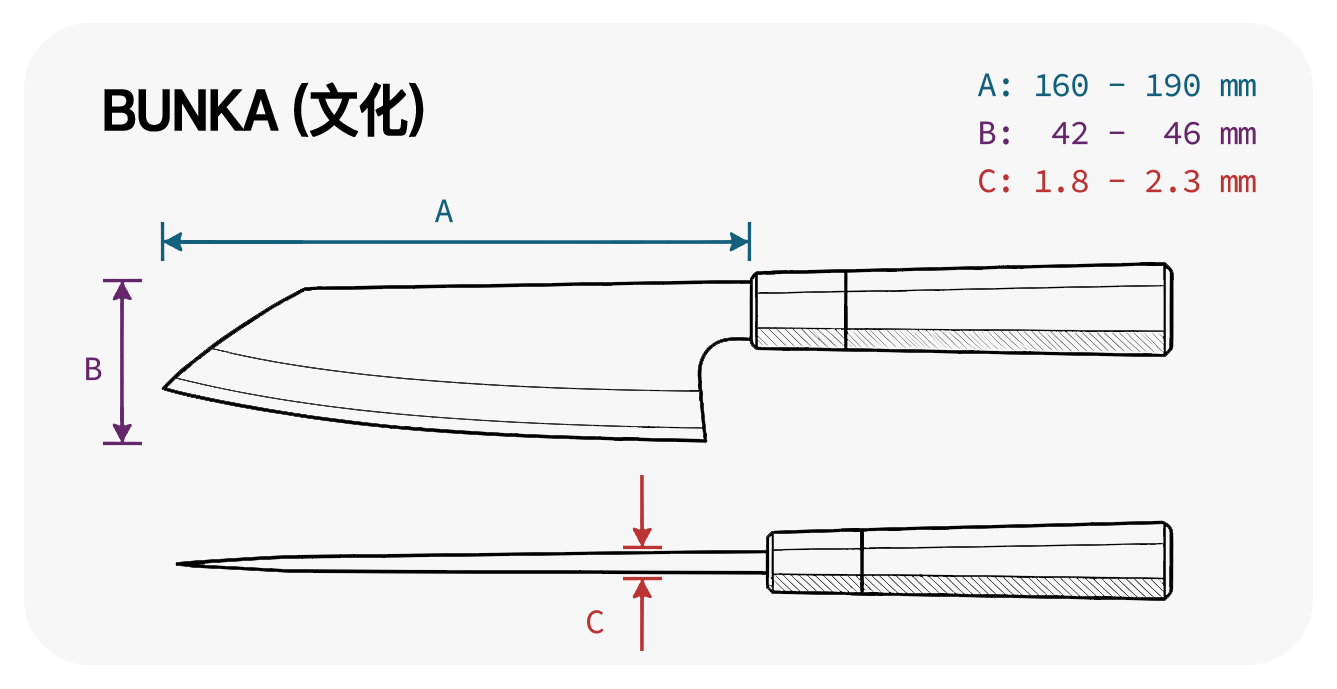
More about Bunka
Translates to "cultural knife." A double-bevel multi-purpose knife featuring a flat cutting edge and an aggressive, angular triangular tip (K-tip or reverse tanto).
The Bunka offers Santoku-like multi-purpose chopping versatility combined with a razor-sharp, nimble point for delicate scoring, detail work, and precise tip slicing.
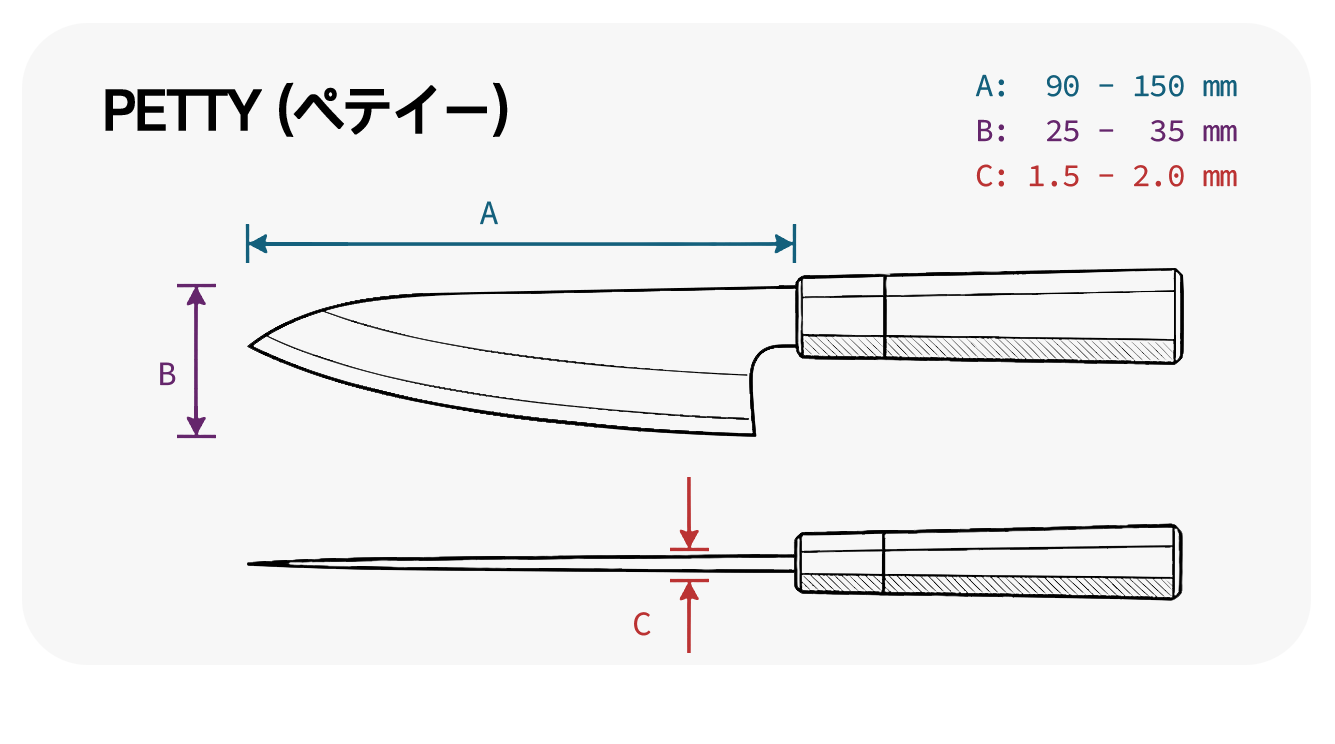
More about Petty
Derived from the French word petite. A small, agile utility knife with a double-bevel edge, scaling down the Gyuto geometry.
This knife fills the gap between a chef's knife and a paring knife—ideal for off-the-board work, peeling, trimming garnishes, and small precise cuts.
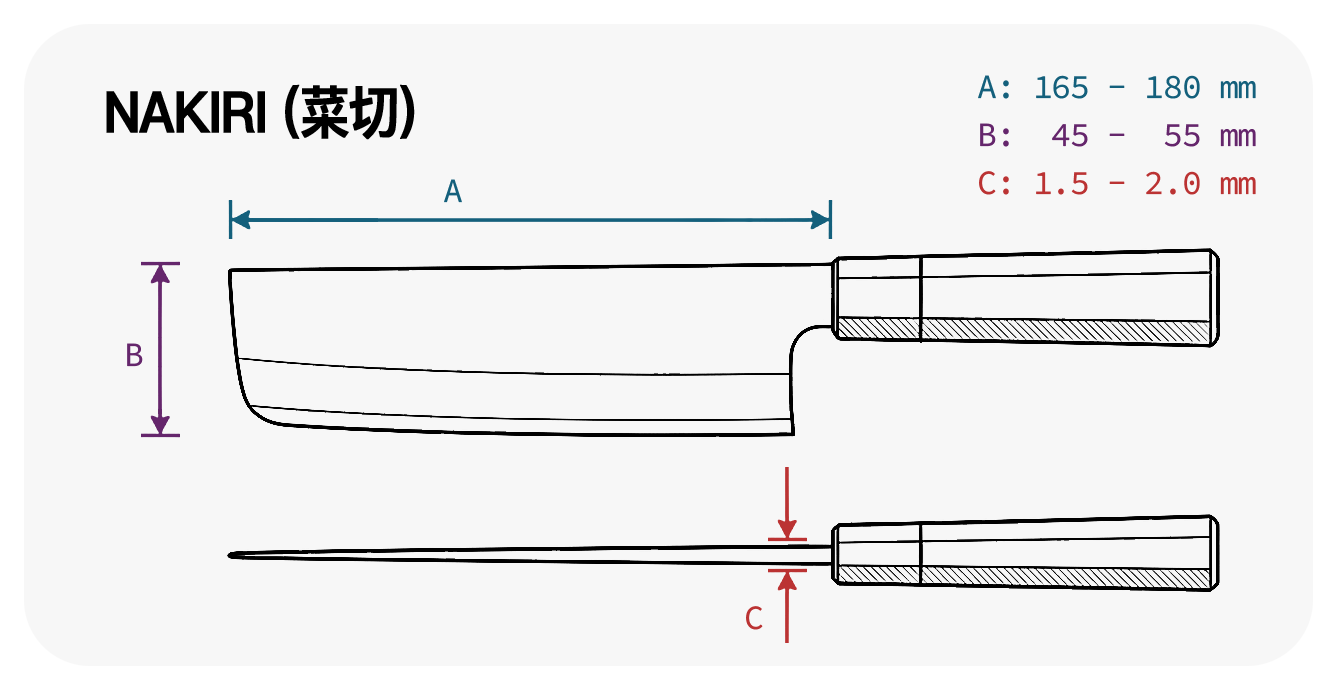
More about Nakiri
Nakiri means "vegetable cutter." A double-bevel rectangular blade featuring a flat cutting edge and a rounded front edge.
This blade is built exclusively for push-chopping and mincing vegetables. Its completely straight edge ensures full board contact without tearing skins.
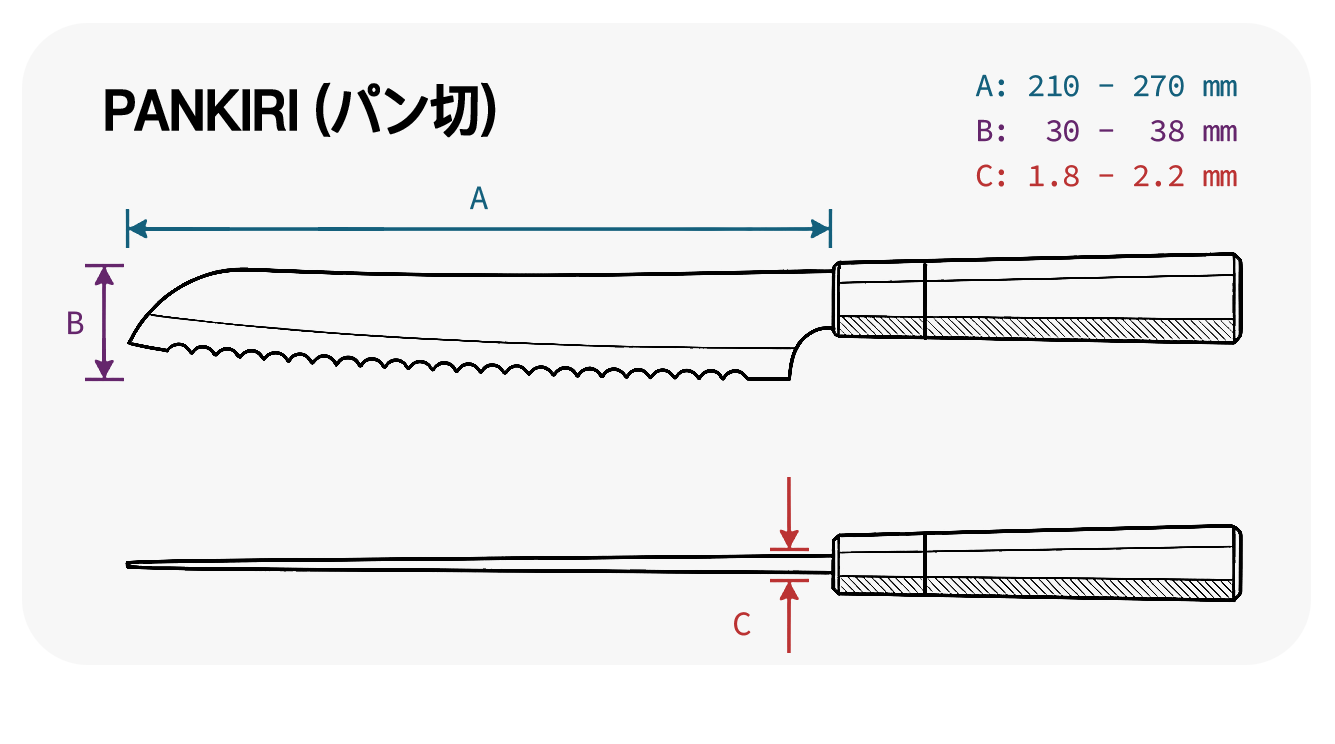
More about Pankiri
Pankiri meaning "bread cutter." A long, narrow double-bevel knife with serrated teeth along the cutting edge.
This knife is engineered to saw cleanly through hard artisanal bread crusts and delicate soft crumbs without crushing or squashing the loaf.
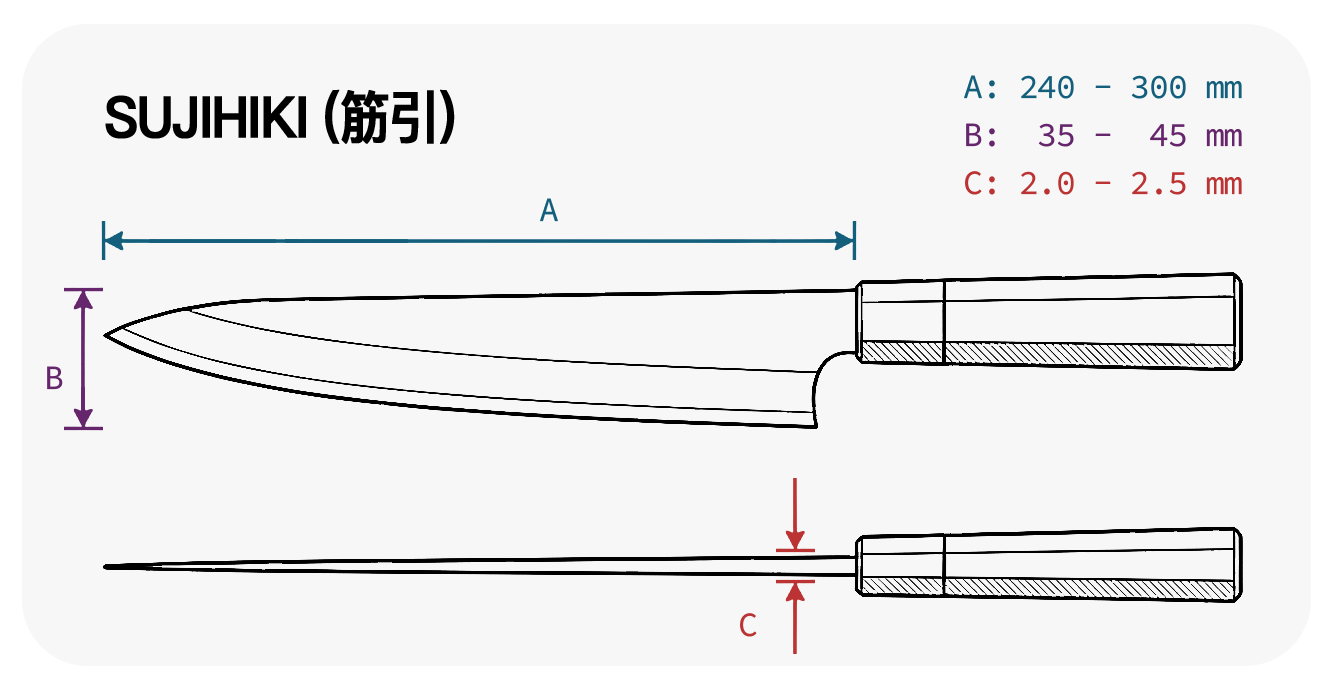
More on Sujihiki
Translates to "muscle puller." A long, low-height, double-bevel carving knife designed with minimal surface drag.
Used for pulling clean, single-draw slices through large roast meats, steaks, and raw boneless proteins to retain juices and preserve clean grain lines.
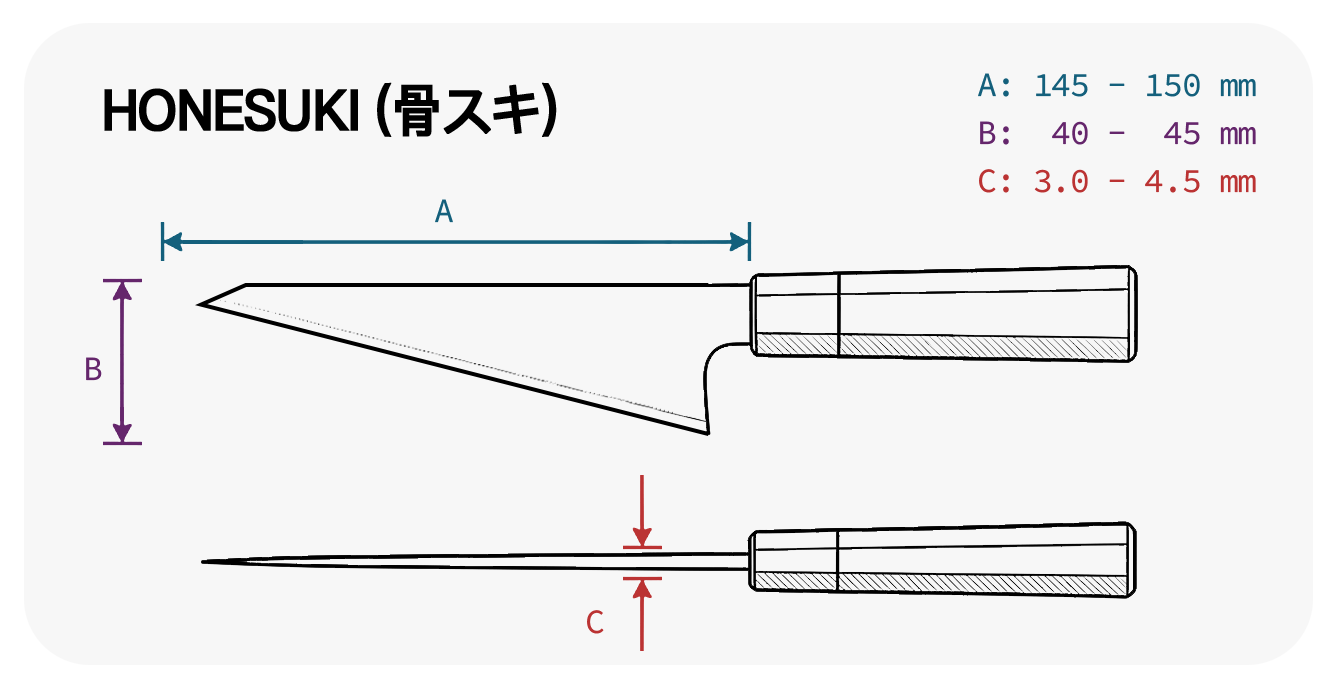
More on Honesuki
Honesuki translates to "bone strip." A stout, rigid double-bevel asymmetrical knife with a thick spine, flat heel, and triangular K-tip profile.
Specially engineered for poultry butchery — breaking down chicken joints, trimming connective tissue, and separating meat from bones without chipping.
Traditional Japanese Knives
This section provides an overview of single-bevel Japanese profiles engineered for specialized task mastery — from razor-sharp sashimi slicing to decorative vegetable carving. Because of their asymmetrical geometry, these knives are handed (left-handed or right-handed), making it crucial to select the version that matches your dominant hand. The illustrations that follow display the standard right-handed profiles.
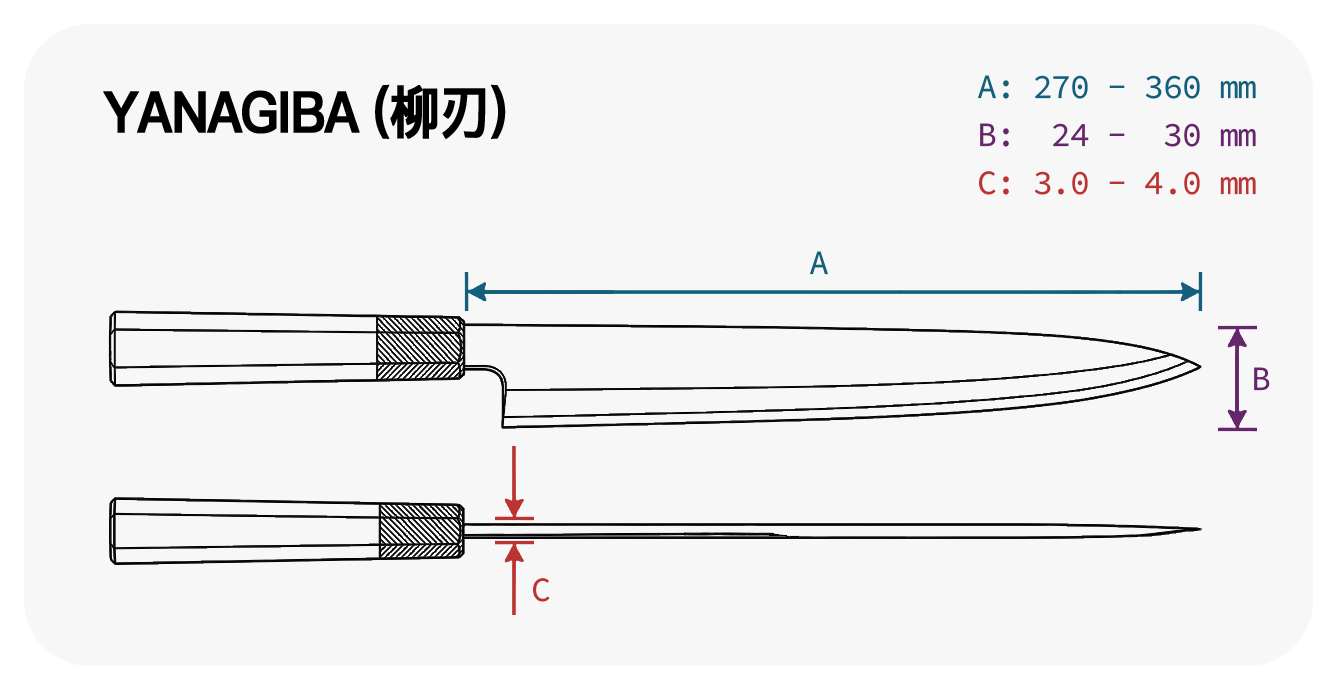
More on Yanagiba
Yanagiba translates to "willow leaf blade." A long, narrow, traditional single-bevel knife featuring a concave back (urasuki) and flat front bevel.
Essential for traditional sushi and sashimi prep. The single-bevel edge cuts shiny, glass-smooth fish slices in a single pulling motion.
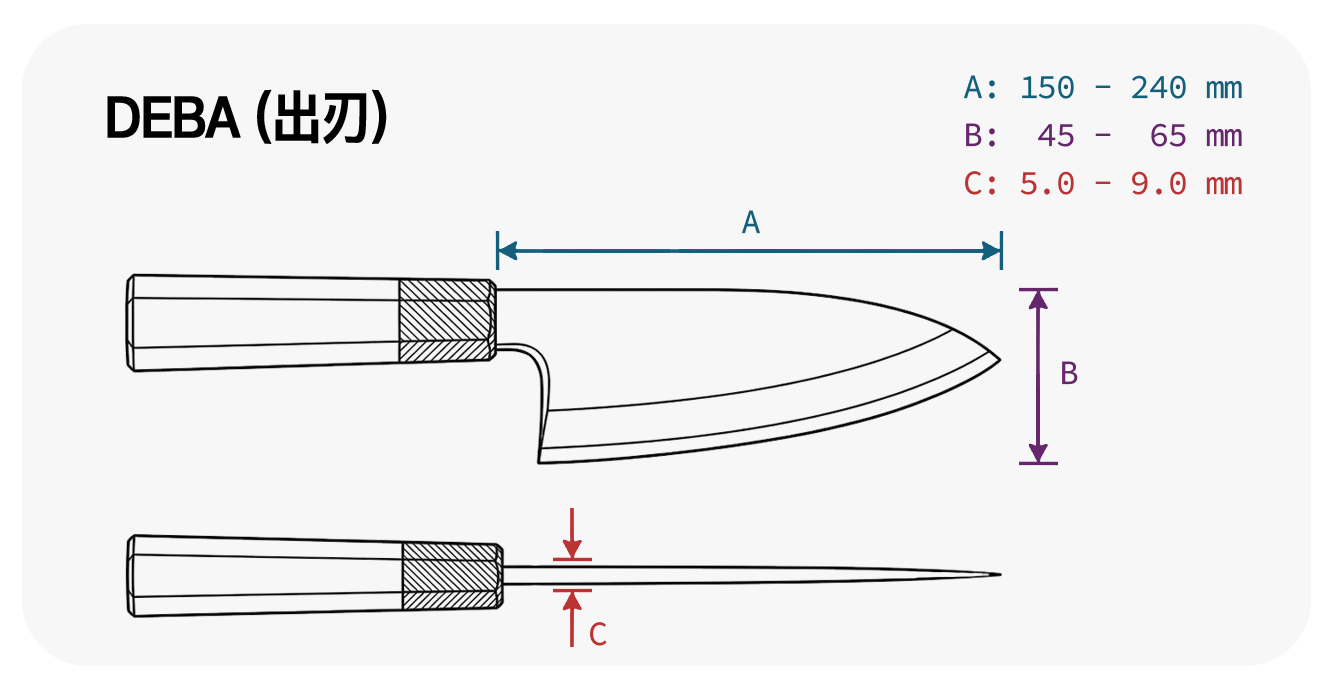
More on Deba
Deba means "pointed carving blade." A heavy, thick single-bevel knife with a high heel, substantial spine weight, and stout wedge geometry.
Designed specifically for fish butchery — filleting whole fish, cutting through small bones, and decapitating heads without risking blade fracture.
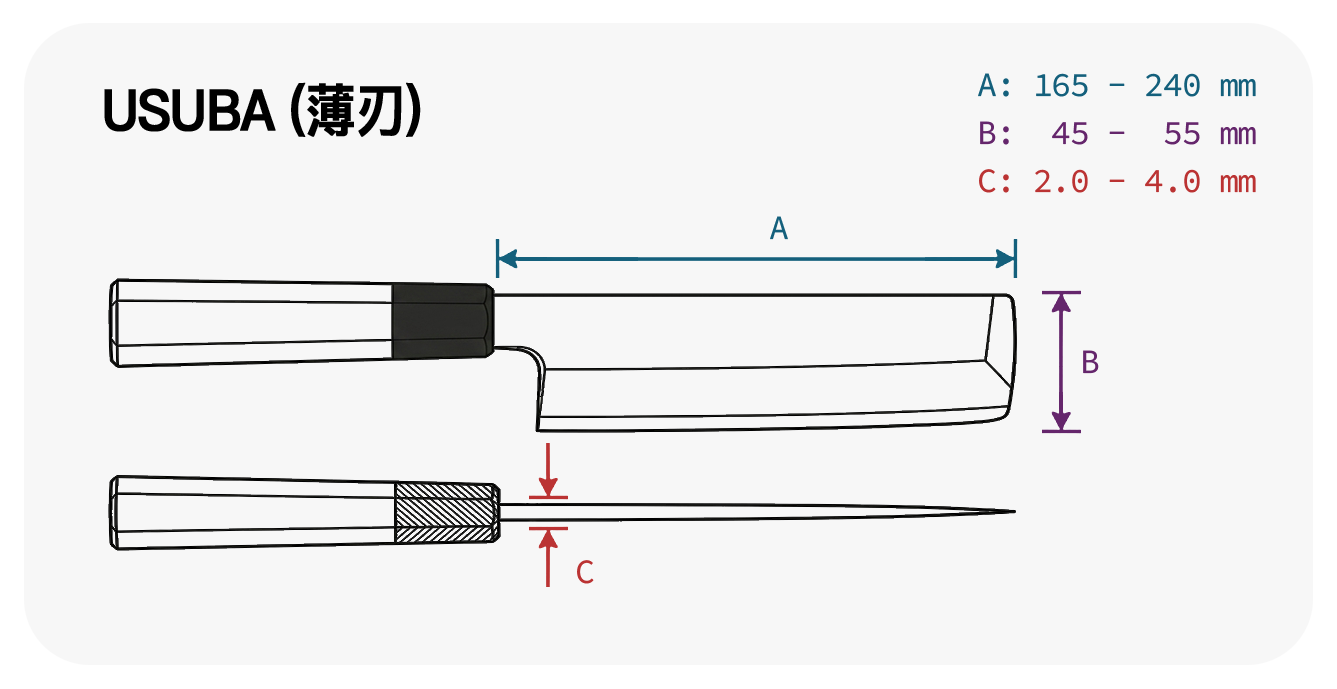
More on Usuba
Usuba means "thin blade." A traditional single-bevel rectangular knife with a flat profile, sharp heel corner, and delicate edge.
Used by professional Japanese chefs for high-precision vegetable work, such as rotary peeling (katsuramuki sheets) and decorative paper-thin slicing.
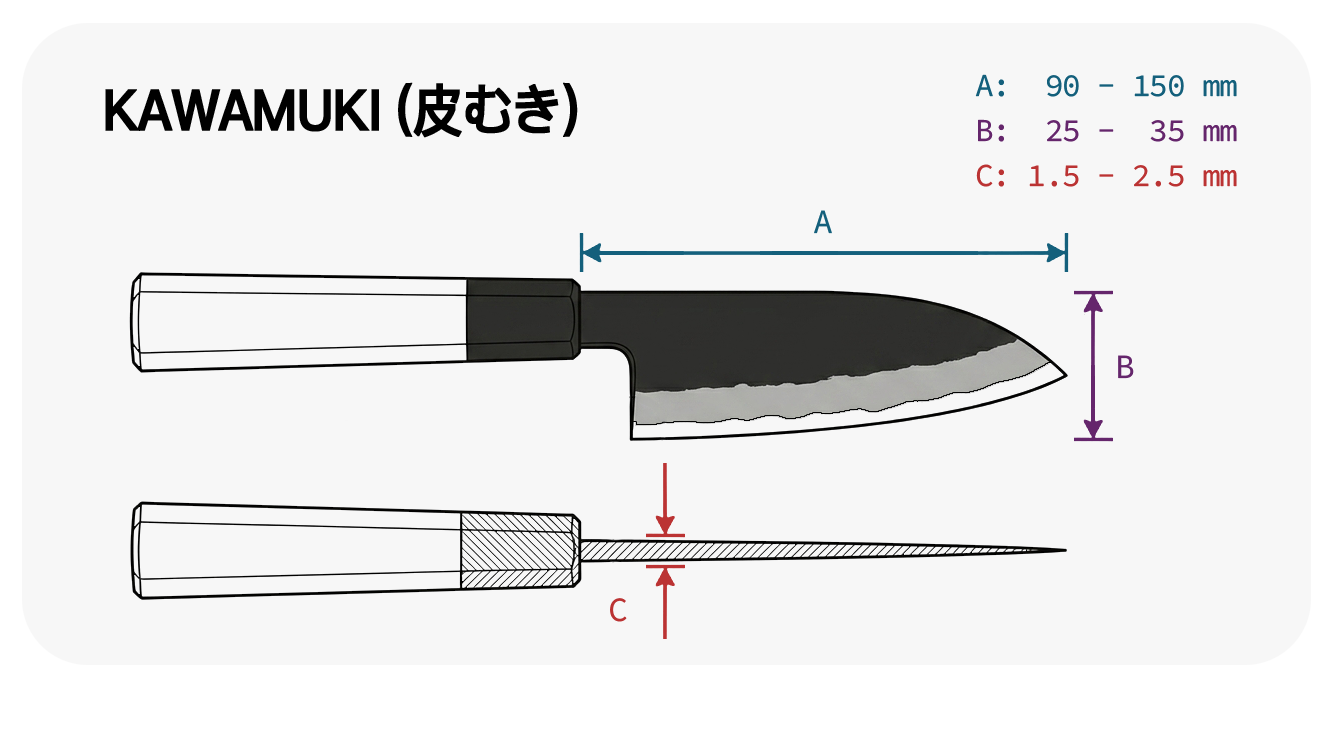
More on Kawamuki
Kawamuki means "skin peeler." A small, short single-bevel utility blade with a curved spine drop.
It is designed for hand-held vegetable shaping, intricate peeling, and carving traditional Japanese garnishes directly off the cutting board.
Kiritsuke / Sakimaru Variants
Both Kiritsuke and Sakimaru profiles draw heavy inspiration from traditional Japanese swordcraft, replacing standard rounded tips with dramatic, specialized geometries.
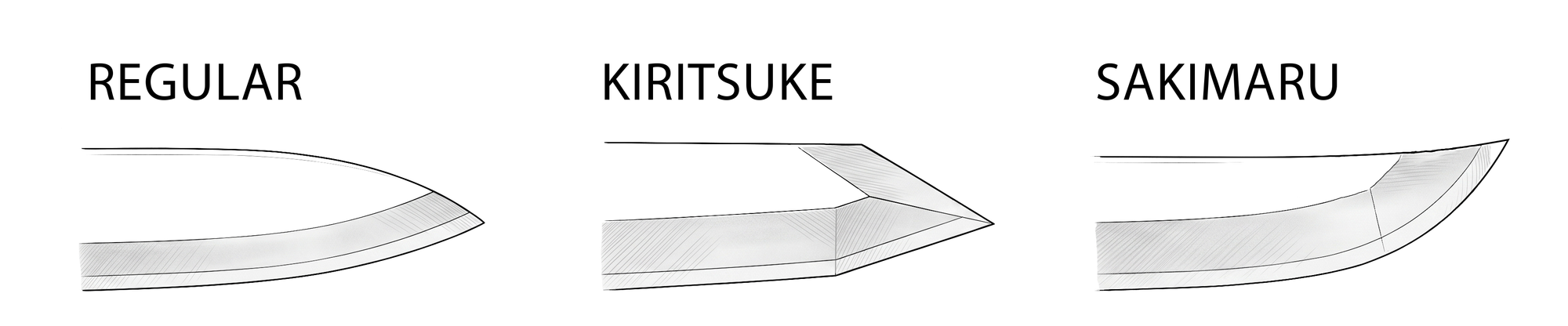
Kiritsuke Variants (K-tip)
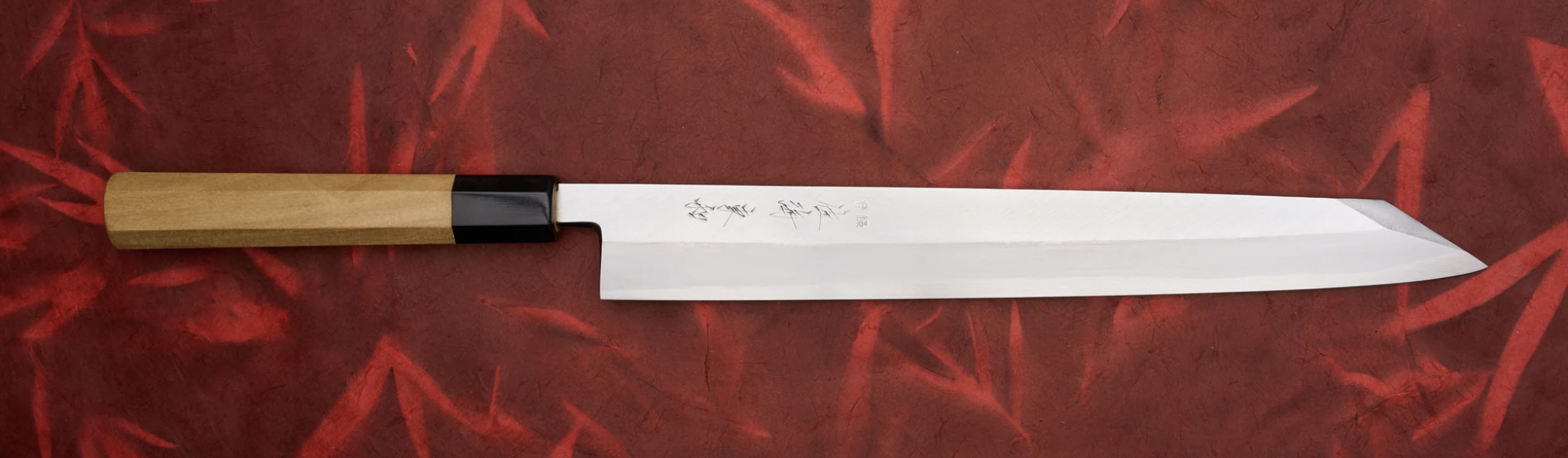
The Kiritsuke (切り付け) is defined by its sharp, angular reverse-tanto tip ("K-tip"). Originally a prestigious, single-bevel head chef's knife in Japan, its aggressive geometry has been broadly adopted in (but not limited to) modern double-bevel knives to add surgical tip control to everyday profiles.
- Pros: Surgical tip sharpness for detailed scoring, piercing, and precision work; flatter edge profile optimized for clean push-cutting and tap-chopping.
- Cons: Delicate tip prone to snapping or micro-chipping; flat profile eliminates Western rock-chopping; requires disciplined technique.
- Kiritsuke Gyuto: Adds sword-like piercing capability and flat heels to chef's knives and long slicers.
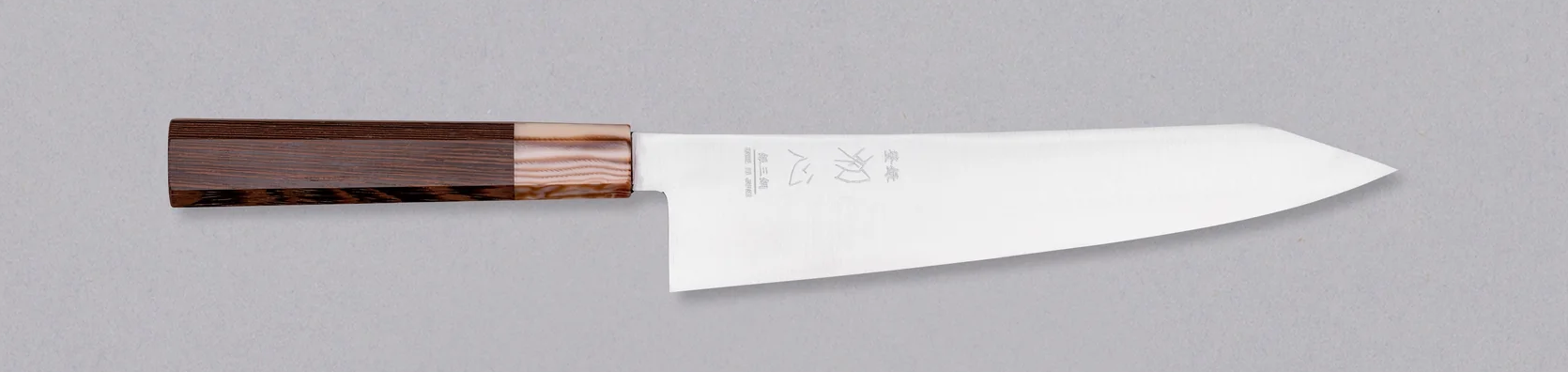
- Kiritsuke Petty: Transforms a small utility knife into a hyper-precise tool for detailed off-the-board work and scoring.

- Bunka / Kiritsuke Santoku: Blends the wide, accessible body of a Santoku with an aggressive K-tip for all-around prep.
- Hakata / Kiritsuke Nakiri: A specialized hybrid that adds a piercing corner to a flat-edged vegetable cleaver. Often considered a regional variation of a Bunka knife.
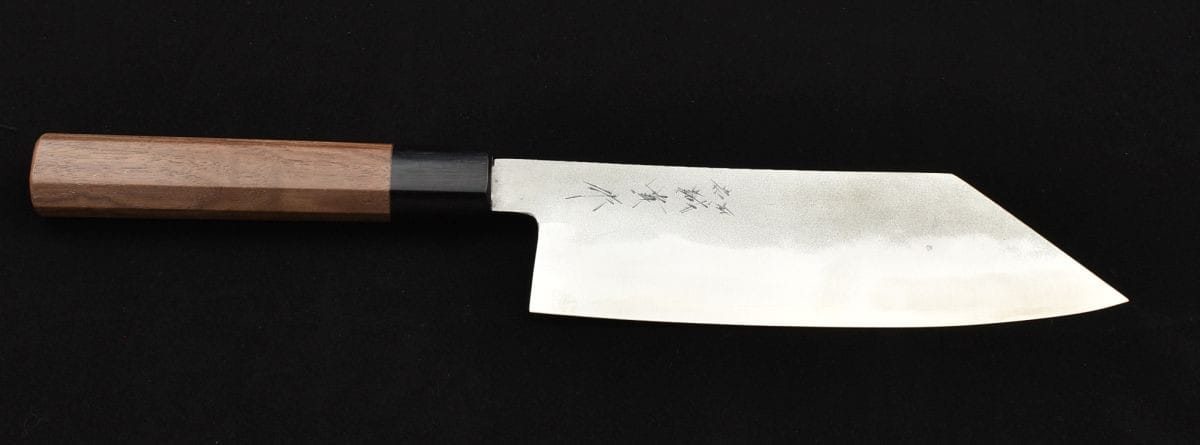
- Kiritsuke Yanagiba: A traditional single-bevel sashimi slicer with a K-tip, designed for ultra-clean, single-stroke raw fish portioning with enhanced tip control.
Sakimaru Variants (Katana-style Tip)
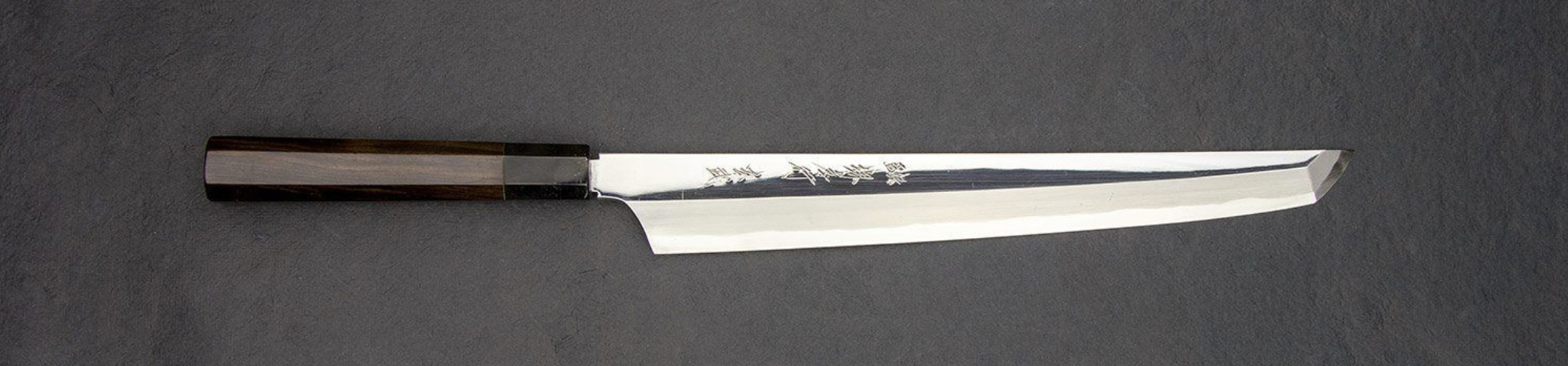
The Sakimaru (先丸) features a distinctive upward-sweeping, rounded tip that directly mirrors the tip of a traditional Japanese Katana (kissaki). Engineered specifically for long slicing motions, it allows the blade to finish long pull-cuts fluidly without the tip catching the cutting board.
- Pros: Striking sword aesthetics; seamless finish on long pulling strokes through raw fish or roasts; reduced board resistance at the tip.
- Cons: Highly specialized for slicing; completely unsuitable for chopping or multi-purpose prep; difficult to sharpen around the tip curve.
- Sakimaru Yanagiba: The primary single-bevel application, combining a long Yanagiba edge with a Katana tip for raw protein portioning and sashimi.
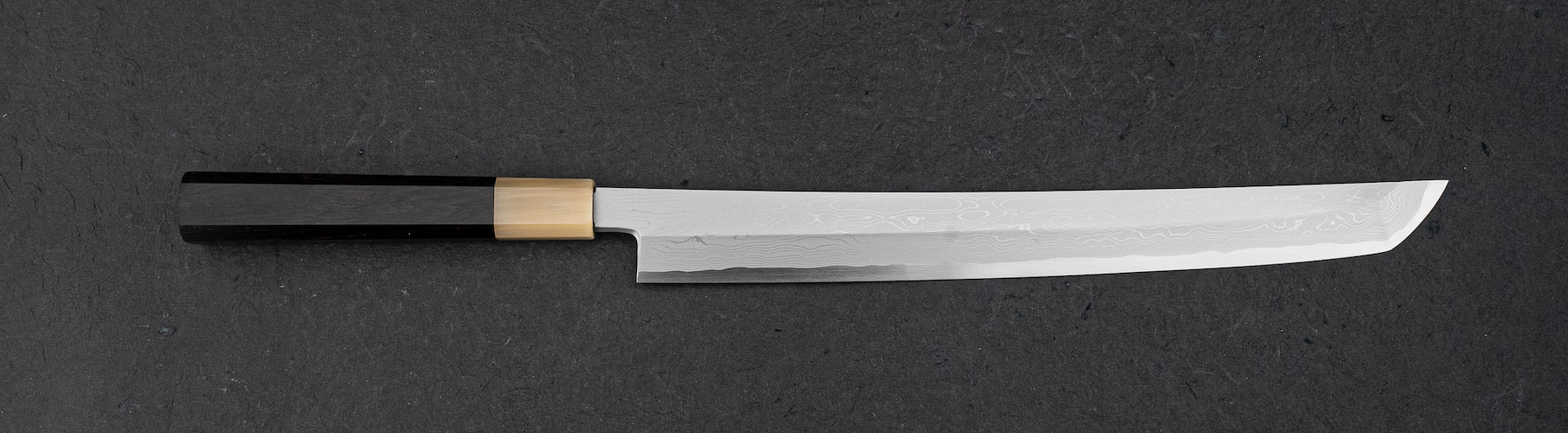
- Sakimaru Takobiki: A modern hybrid of the traditional square-ended octopus slicer, replacing the blunt tip with an elegant upward Katana curve.
Japanese Task-Specific Knives
This final, conclusive category covers hyper-specialized, single-task Japanese blades — where geometry, weight, and balance are tailored exclusively to one ingredient or technique. Virtually useless for the home chef, these knives are included here purely for culinary curiosity and completeness.
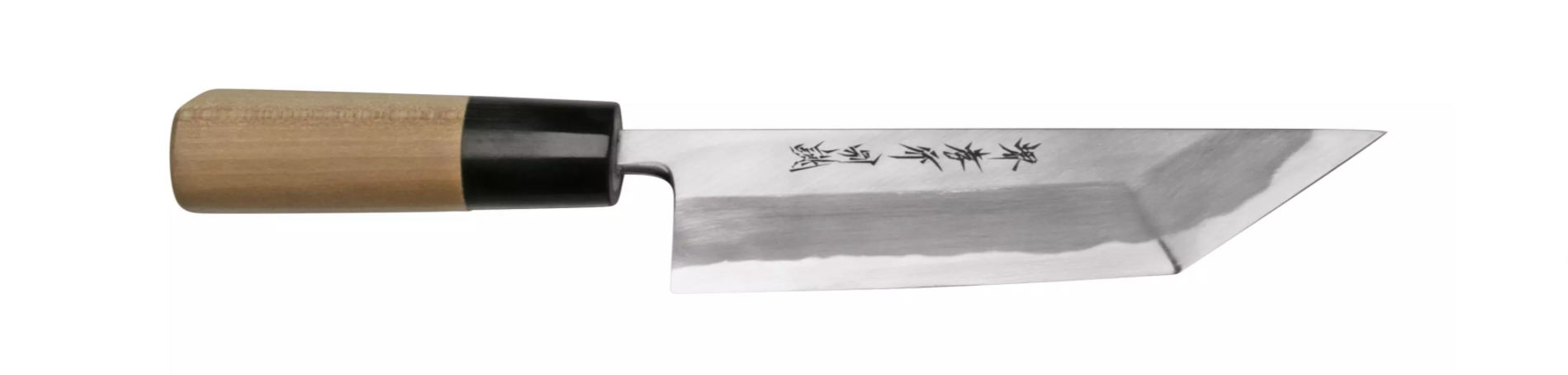
- Unagisaki (Eel Knife): A heavy, wedge-shaped blade with regional tip variations, built to fillet eel in a single, rapid pass.
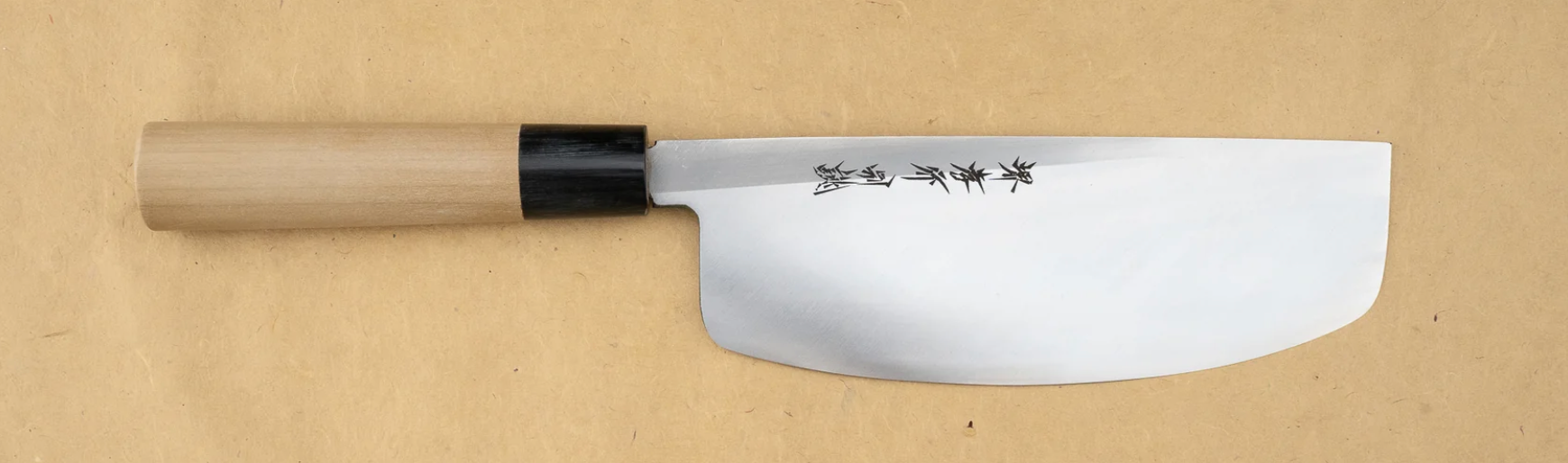
- Sushikiri (Sushi Slicer): A tall, crescent-curved blade designed to slice sushi rolls (maki) and pressed blocks (oshizushi) in a gentle rocking motion without crushing rice.
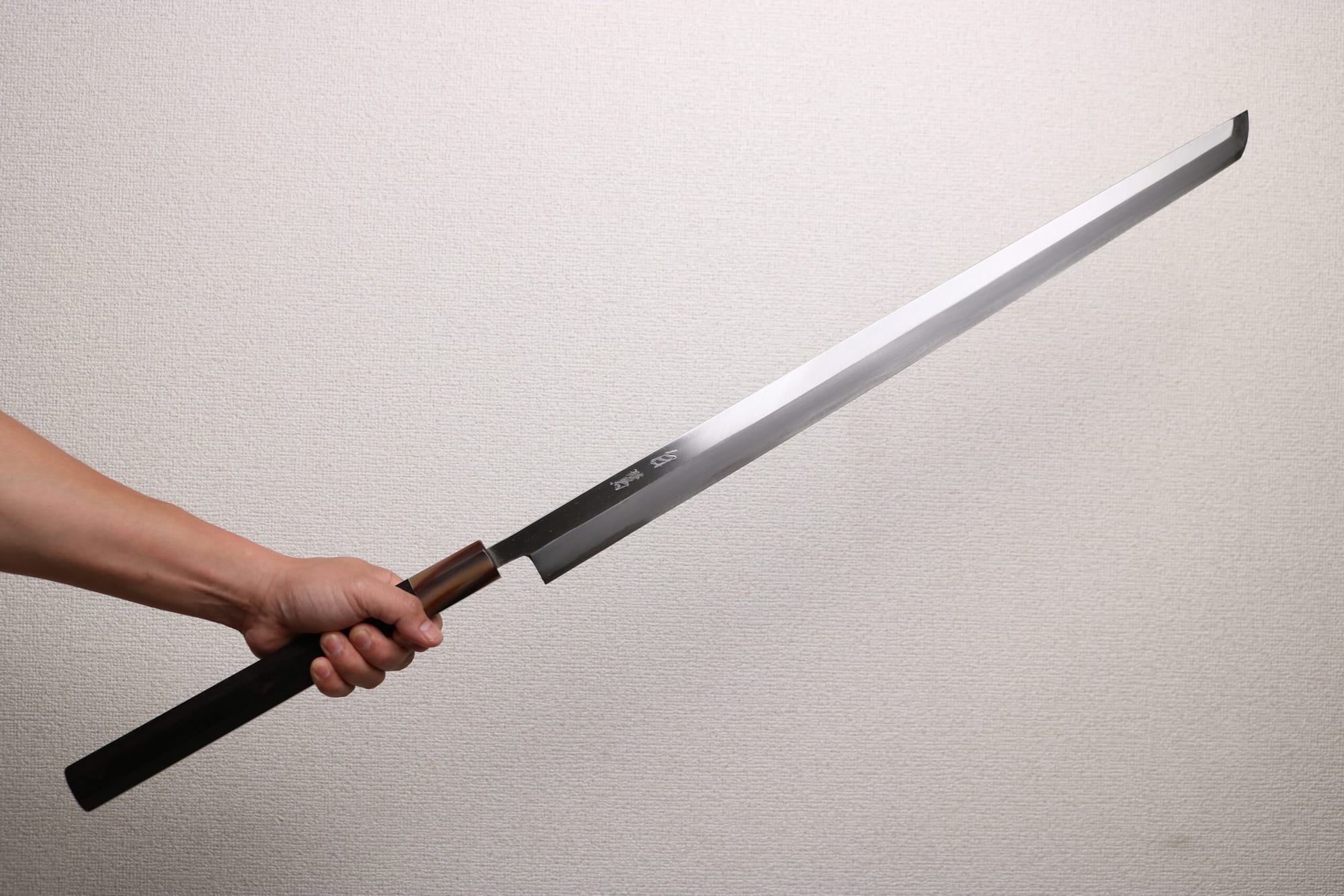
- Magurokiri (Tuna Sword): A massive single-bevel blade—often reaching 60 cm to 150 cm in length — forged solely to butcher giant whole bluefin tuna.
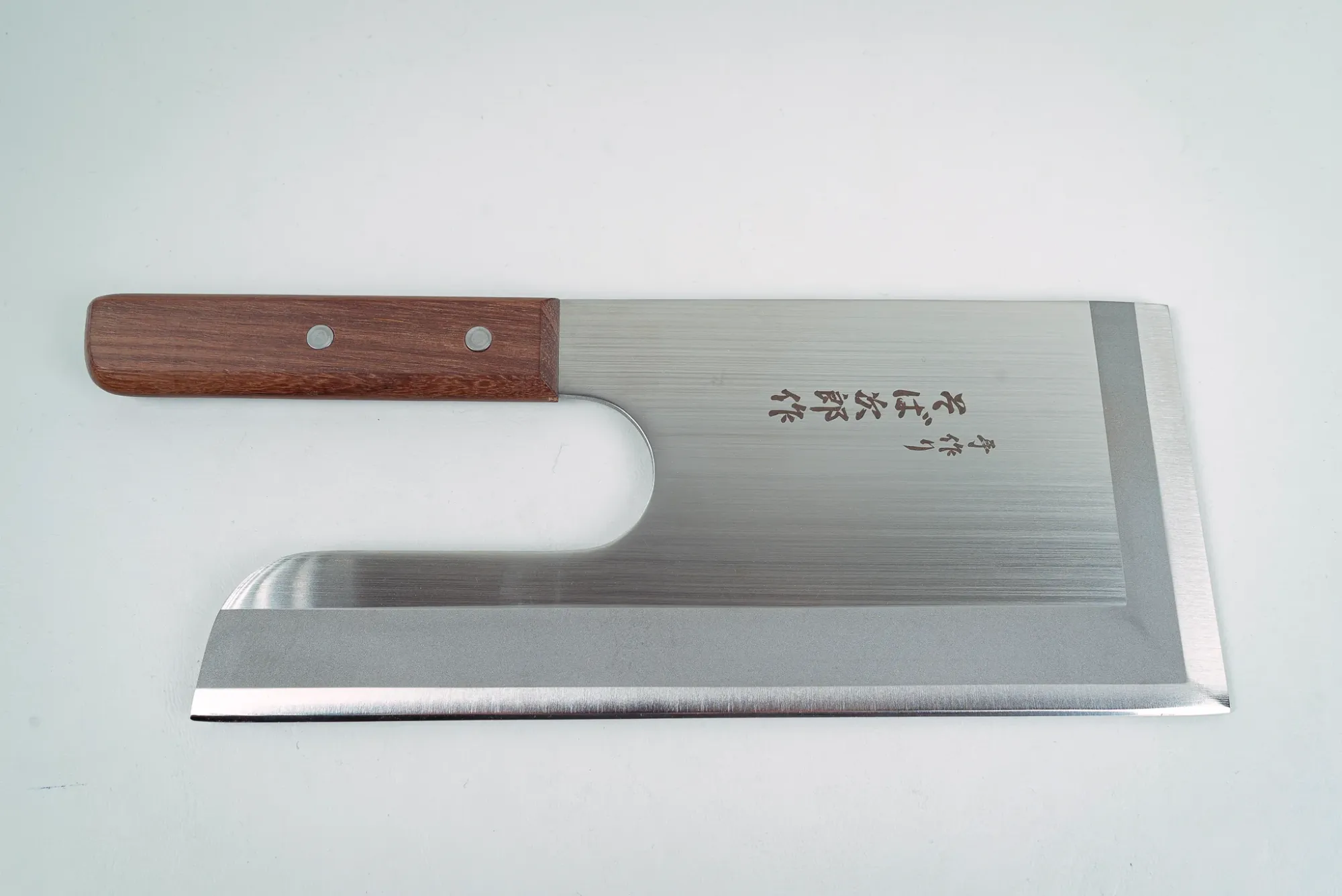
- Sobakiri (Noodle Cleaver): A heavy, flat-edged cleaver with an extended over-spine handle, built to drop straight down through folded buckwheat dough and noodles for uniform cuts.
Handle Types & Materials
While blade geometry determines how a knife cuts, handle construction dictates how it feels and responds in hand. Selecting the right shape and material aligns a blade's weight distribution directly with your cutting technique.
Western (Yo-Handle / 洋柄)
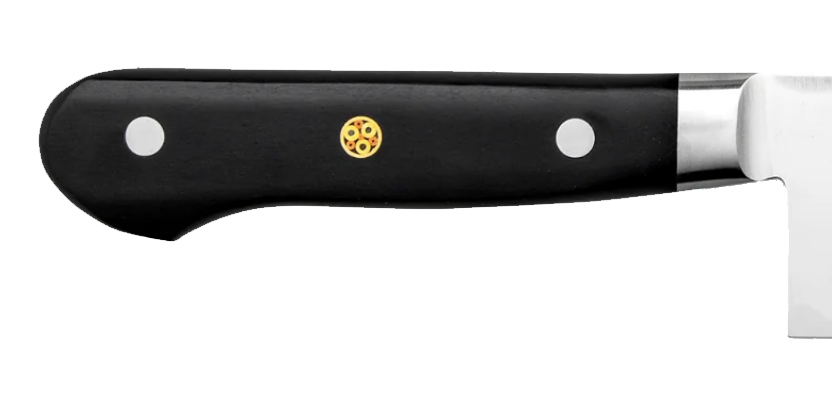
Full-tang design featuring handle scales attached to a solid steel tang with steel rivets. It features a heavy, robust and handle-balanced profile; designed for power chopping and full-palm grips.
Traditional Japanese (Wa-Handle / 和柄)
Lightweight wooden handle fitted onto a narrow hidden tang (nakago) using resin or friction, pushing the balance forward onto the blade to favour precision and control.
Wa-Handle Shapes
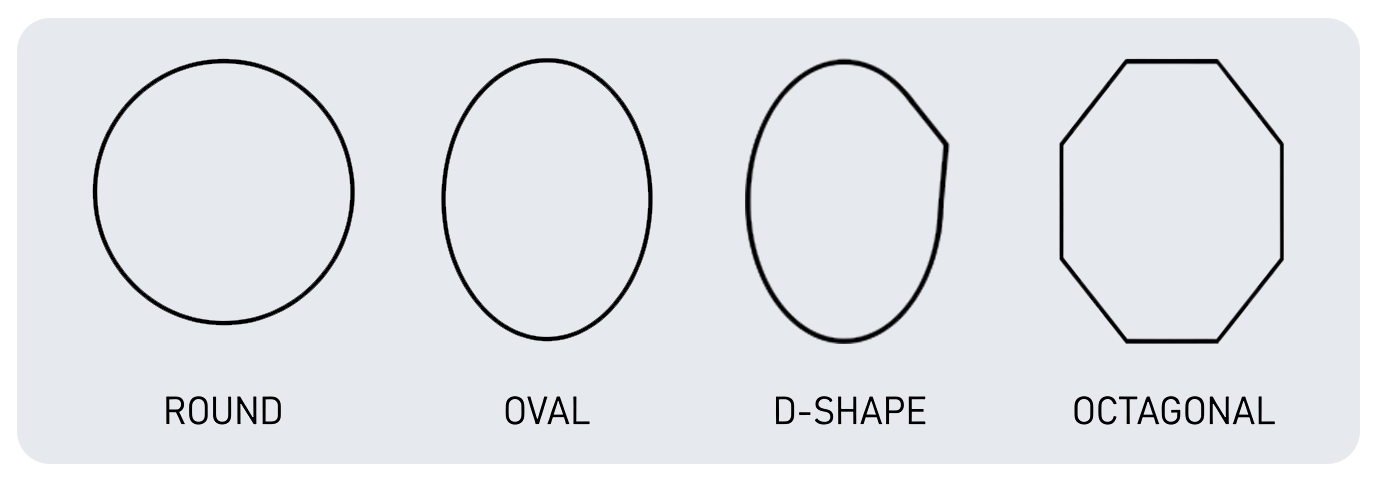
The Wa-handle features several cross-section profiles:
- Octagonal (Hakkaku): Symmetrical eight-sided profile providing clear corner-indexing and a secure grip for either hand.
- D-Shape (Shinogi): Asymmetrical profile with a raised finger-rest ridge; explicitly hand-specific (right- or left-handed).
- Round: Symmetrical, hand-agnostic, this is the most traditional handle shape, and it is curiously only used in Japan, thus it is almost impossible to find outside, on knives made for export.
- Oval (Maru): Smooth, rounded cross-section allowing seamless hand position adjustments without pressure points.
- Hybrid & Modern Synthetic: Integrates Western ergonomic hand contours with Japanese blade-forward balance, using non-porous materials for higher hygiene.
Handle Materials
Handle materials range from traditional softwoods to high-tech composites, impacting on grip texture, weight, moisture resistance, and maintenance needs.
This is a very compact and synthetic list, that I integrated for completeness.
- Natural Woods: Magnolia (Ho Wood) (traditional, lightweight, soft-touch), Hardwoods (walnut/oak), and Dense Exotics (ebony/ironwood; oil-rich, water-resistant).
- Composites: Pakkawood (resin-infused wood; waterproof), Micarta (canvas/linen resin; non-slip when wet), and G10 (glass-fiber epoxy; indestructible).
- Synthetics & Metals: POM (dense, hygienic Western plastic) and Stainless Steel / Titanium (seamless, moisture-proof).
- Ferrules & Accents: Buffalo Horn (traditional, locks around tang) or Resin / Metal (durable, zero-maintenance collars).
Reference & Bibliography
- Dream of Japan from Kei Nishida is a nice page with additional details and great graphics on the cross section of single-bevel and double bevel knives
- The Structure of a Single Edge Knife by Sakai Ichimonji Mitsuhide is perhaps the most clear and complete explanation on the internet about the anatomy of a single-bevel knife.
- The Burrfection Store is an online resource with an exhaustive list for the Japanese knife types. This online shop is well documented and structured, providing plenty of useful info on all knife types.
- SharpEdge Store has a section with an interesting explanation on Wa-handles
Continue Reading...
 Luca Mennoia