The Art of the Cut: the Soul of Steel
In this third installment, I break down steel metallurgy, the Rockwell scale, and my custom framework I conceptualized as a tool for evaluating knife alloys. Bored? Skip straight to the conclusion. But if you want to master steel selection, dive in—it's built to be your ultimate reference guide!

Introduction
Selecting a steel is a technical task which requires a good and broad knowledge of the Rockwell scale and metallurgy, knife and bevel types. Fully understanding trade-offs and conveniences can be tricky, even for an experienced person.
I am not an expert myself but whilst extremely curious, I have managed through my research to get a decent understanding of steels so to be aware of what I am buying when selecting a knife over another. Of what I am losing or gaining on selecting an Aogami Super over a VG-10, for example.
You can trace back to the previous post with the link below.
 Luca Mennoia
Steel Metallurgy & Rockwell Scale
To truly understand how a knife performs on the cutting board—why it slices effortlessly, holds its edge for months, or suddenly chips against a chicken bone—you have to look beyond edge geometry and analyze the steel itself.
Metallurgy: Steel Tension Triangle
Through my research I could identify a fundamental Metallurgical Triad at the heart of every blade’s physical behavior: these three distinct mechanical properties constitute a good base for a framework which will help classifying steels and lead to a fully aware selection when choosing a knife.
- Hardness (HRC): material's resistance to localized surface penetration and plastic deformation (standardized via the Rockwell C test, ASTM E18).
It dictates apex keenness and wear resistance, determining a knife's edge retention i.e. how long an edge stays razor-sharp under normal cutting friction. - Toughness (J): the ability of the steel to absorb sudden impact energy without fracturing (measured via the Charpy pendulum impact test, ASTM E23). This is basically a blade's "insurance policy", preventing chipping and catastrophic fracture when hitting hard obstacles like bones or frozen foods.
- Ductility (%EL): the extent to which steel can undergo permanent plastic stretching or bending under sustained tension before snapping (measured via tensile testing, ASTM E8). High ductility makes a blade forgiving, causing the microscopic cutting apex to roll or a thin tip to bend under lateral stress rather than break off cleanly.
How to read the triangle
The closer a steel's chart pulls toward a specific corner, the stronger it is in that single trait — and the more it sacrifices the other two.
A full-sized equilateral triangle chart represents the holy grail of metallurgy: an ideal condition, impossible to realize.
A tiny, shrunken triangle means cheap steel or a bad heat treatment.
Every gain in one property inherently forces a compromise in another.
The triad triangle is but a tension map balancing these competing physical qualities.
Maximizing hardness increases edge retention, but physics dictates that toughness drops. The steel becomes brittle, meaning it will micro-chip instead of absorbing hard impacts.
Lowering the hardness allows higher ductility, so the razor edge will fold (roll) or the tip will bend under side-to-side pressure rather than snapping. But this will require more frequent sharpening operations.
The Rockwell Scale (HRC)
The Rockwell Hardness Scale C (HRC) serves as the universal benchmark for measuring cutlery steel hardness. The testing process involves driving a diamond cone into a steel sample under a standardized load; a smaller indentation depth yields a higher HRC value. Because hardness, toughness, and ductility are inherently interdependent properties, the HRC rating stamped on high-end knife packaging reveals far more than just how long a blade holds an edge.
Here I provide a brief breakdown of the relevant HRC spectrum:
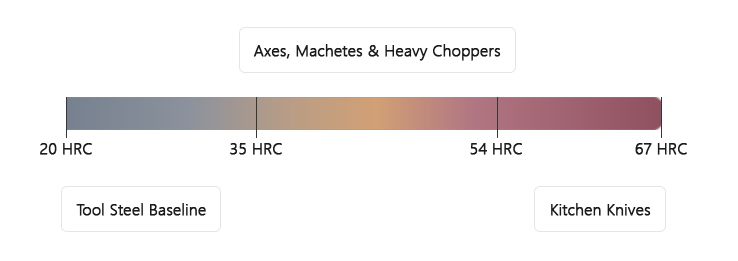
- Infra-Scale (<20 HRC): Below 20 HRC, steel behaves like soft structural iron. With this HRC score, steel suffers from immediate plastic deformation under minimal force. Any cutting apex made with such a material will easily fold flat on the first slice.
- 20 – 35 HRC (Un-hardened & Tool Steel Baseline): Raw or annealed stock. Steel in this range can easily be machined, ground, and drilled, but it lacks the elastic yield strength to support a cutting apex.
- 35 – 54 HRC (Axes, Machetes & Heavy Choppers): Shock-absorption zone. Designed for high dynamic impact where edge retention and precision is secondary. The steel deforms or rolls upon striking hard obstacles rather than fracturing.
- 54 – 67 HRC (Kitchen Knives & Fine Cutlery): The performance sweet spot. Steel achieves high enough yield strength to hold a keen apex and resist abrasive wear from food fibers and cutting boards. This final region is where we’ll zoom in to map the specific knife steels that matter most.
- Ultra-Scale (>67 HRC): Pushing iron-based steel past 67 HRC stresses it beyond its physical stability limit. The edge turns glass-brittle, crumbling from internal residual strain before it even hits a cutting board.
Zooming Into HRC Scale
The Rockwell scale appears linear, but in terms of practical blade performance, a difference of just 3–4 points fundamentally alters how a knife behaves in your hand:
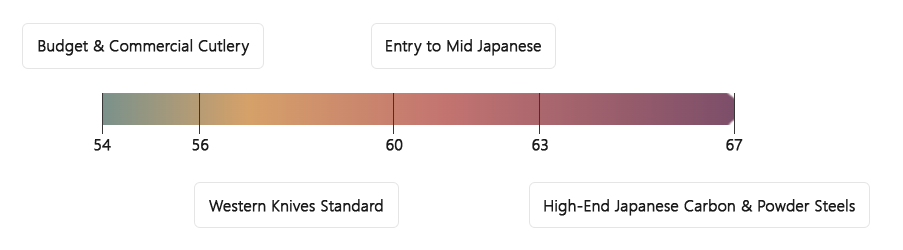
- 54 – 55 HRC (Budget & Commercial Cutlery): soft, elastic, and forgiving. Steel at this level is inexpensive to produce and virtually immune to chipping, even under severe abuse or improper technique (such as cutting against ceramic plates or twisting through hard crusts).
The trade-off is low-edge retention: the tip will deform and roll over quickly under basic downward compression, requiring near-constant re-sharpening to stay functional. - 56 – 58 HRC (Western Standard): Tough and resilient. The steel remains ductile enough to flex microscopically under stress rather than snap. When the edge eventually dulls, it has typically rolled over rather than shed metal, allowing you to quickly realign the edge using a standard honing rod.
- 60 – 62 HRC (Entry to Mid Japanese): Rigid and sharp. The steel locks into a far more unyielding structure, holding an acute edge angle for significantly longer periods. However, because the metal lacks ductility, a traditional honing rod will no longer push the edge back into place but cause chipping. From this point up, whetstones become non-negotiable.
- 63 – 66+ HRC (High-End Japanese Carbon & Powder Steels): Extreme rigidity. These alloys allow blacksmiths to shape blades paper-thin behind the edge, creating effortless, laser-like slicing performance. The trade-off is high brittleness: twisting the blade on a wooden board, cutting into semi-frozen food, or striking poultry bone can easily chip or crack the cutting edge.
Knife Steels
Selecting the right knife steel is all about handling trade-offs: balancing hardness, edge retention, sharpness, toughness, ease of sharpening, and corrosion resistance. No single alloy excels in every category. Once you understand how metallurgy, HRC, and geometry contribute to cutting performance, you can match a blade's practical characteristics directly to your cutting style and maintenance preferences.
Below is an extensive breakdown of the most relevant cutlery steels on the market, grouped into four core performance families:
- Pure Carbon Steels
- Conventional Stainless Steels
- Semi-Stainless & Tool Steels
- Advanced Powder Metallurgy (PM) Steels
1. Pure Carbon Steels
High-purity iron-carbon alloys engineered for surgical keenness and intuitive waterstone feedback. Highly reactive (non-stainless) and prone to oxidation/patina.
- Shirogami #1 (White #1): Manufactured by Hitachi Metals in Japan at 63–65+ HRC, Shirogami #1 features the highest carbon purity (~1.25–1.35% C), capable of taking the sharpest, most acute edge possible in traditional Japanese bladesmithing at the expense of being slightly more brittle and unforgiving to forge.
- Shirogami #2 (White #2): Manufactured by Hitachi Metals in Japan at 61–63 HRC, Shirogami #2 is the most popular, versatile White steel alloy (~1.05% C), delivering an unmatched balance of razor-like sharpness, clean tactile feedback, and excellent waterstone responsiveness, though it rusts rapidly without immediate care.
- Shirogami #3 (White #3): Manufactured by Hitachi Metals in Japan at 60–62 HRC, Shirogami #3 is the lowest-carbon entry in the White Paper series (~0.8–0.9% C), making it the toughest and most chip-resistant of the three while taking a surgical edge and offering effortless stone sharpening.
- Aogami #1 (Blue #1): Manufactured by Hitachi Metals in Japan at 63–65 HRC, Aogami #1 contains higher carbon (~1.2–1.4%) and tungsten content than Aogami #2, providing higher wear resistance and edge retention for precision cutting tasks at a slightly higher hardness.
- Aogami #2 (Blue #2): Manufactured by Hitachi Metals in Japan at 62–64 HRC, Aogami #2 is created by adding tungsten (~1.0–1.5%) and chromium (~0.3–0.5%) to Shirogami #2, significantly enhancing wear resistance and edge life under heavy board work while remaining relatively easy to maintain.
- Aogami Super (AS): Manufactured by Hitachi Metals in Japan at 64–66+ HRC, Aogami Super is the top tier of non-powdered carbon steels, alloyed with high carbon (~1.45%), tungsten, chromium, molybdenum, and vanadium to deliver maximum edge retention that rivals modern stainless PM alloys.
- SK95 (SK-5): Manufactured by industrial Japanese mills to JIS standards at 57–59 HRC, SK95 is an affordable, standard industrial tool steel that is tough and easy to sharpen, though it features a coarser carbide grain structure than Shirogami.
- Takefu Shiro2: Manufactured by Takefu Special Steel in Japan at 58–60 HRC, Takefu Shiro2 is an unalloyed high-purity carbon steel that offers crisp, effortless sharpening and acute edge stability at a slightly more forgiving hardness level than Hitachi White steel.
2. Stainless Steels
Ingot-cast alloys offering dependable corrosion resistance alongside varied levels of toughness and edge life. These steels contain at least 12–13% Chromium to resist rust and staining under daily prep conditions.
- VG-10: Manufactured by Takefu Special Steel in Japan at 59–61 HRC, VG-10 is the ubiquitous Japanese stainless benchmark used widely by brands like Shun and Tojiro. It offers strong edge retention and rust resistance, though its large carbide structure makes it prone to micro-chipping under lateral torque.
- VG-1: Manufactured by Takefu Special Steel in Japan with a target hardness of 58–61 HRC, VG-1 is the high-carbon ingot precursor to VG-10, alloyed with molybdenum for solid edge stability and corrosion resistance. It takes a very keen edge and is noticeably easier to resharpen on waterstones than VG-10, sacrificing a bit of peak edge life to gain significantly better chip resistance in mid-tier production cutlery.
- VG-7: Manufactured by Takefu Special Steel in Japan at 60–62 HRC, VG-7 is a specialized alloy designed to bridge traditional ingot steels and powder metallurgy by incorporating tungsten, vanadium, and molybdenum for superior edge life and apex stability over VG-10 without becoming overly brittle.
- VG-Xeos: Manufactured by Takefu Special Steel in Japan with a target hardness of 59–61 HRC, VG-Xeos is a next-generation stainless steel engineered with advanced melting techniques and a refined chromium matrix to deliver extreme resistance to pitting and rust that far surpasses VG-10 while maintaining high chipping resistance in acidic environments.
- ZA-18: Manufactured by Aichi Steel in Japan at 61–62 HRC, ZA-18 is a modern cobalt-bearing stainless steel engineered with higher carbon, chromium, and cobalt content than VG-10 to deliver superior edge retention, corrosion protection, and chip resistance in modern multi-layer chef knives.
- Ginsan (Silver #3): Manufactured by Hitachi Metals in Japan at 60–62 HRC, Ginsan is known as the "carbon-like" stainless steel due to a fine-grained chromium structure that mimics the forging feel, waterstone feedback, and acute sharpness of White Carbon steel while remaining completely rust-resistant.
- FC61 (Fine Carbide 61): Manufactured by Sandvik in Sweden and heat-treated by Zwilling/Miyabi to 61 HRC, FC61 is a trade name for the AEB-L / 13C26 razor steel family, featuring a microscopic carbide structure that enables high sharpness, good toughness, and easy sharpening.
- X50CrMoV15: Manufactured by various European mills (ThyssenKrupp/Aperam) at 55–57 HRC, X50CrMoV15 is the standard workhorse of classic Western cutlery (Wüsthof, Zwilling, Victorinox), heat-treated for maximum ductility and impact resistance to be virtually immune to chipping at the cost of requiring frequent honing.
- AEB-L / 13C26: Manufactured by Uddeholm/Sandvik in Sweden at 60–62 HRC, this steel was originally developed for razor blades and features exceptionally fine carbides that deliver high impact toughness, razor keenness, and chip resistance at acute grinding angles.
- ATS-34: Manufactured by Hitachi Metals in Japan at 60–61 HRC, ATS-34 is a legendary vacuum-melted ingot stainless steel offering high wear resistance and strong edge retention, serving as the historical precursor to modern powder alloys in custom cutlery.
- N685 Extra: Manufactured by Böhler-Uddeholm in Austria/Germany at 57–59 HRC, N685 Extra is a nitrogen-enhanced martensitic stainless steel that delivers reliable edge stability, solid corrosion protection, and easy maintenance in production kitchen knives.
- AUS-8: Manufactured by Aichi Steel in Japan with a target hardness of 57–59 HRC, AUS-8 is the classic Japanese entry-to-mid-range workhorse alloy. Featuring a lower carbon content (~0.75%), it is exceptionally tough, highly chip-resistant, and effortless to touch up on stones, making it forgiving under high-volume commercial prep work despite moderate edge retention.
- AUS-10: Manufactured by Aichi Steel in Japan with a target hardness of 59–61 HRC, AUS-10 is the higher-carbon (~1.05%) upgrade to AUS-8, engineered as a direct competitor to VG-10. It delivers edge retention comparable to VG-10 thanks to added vanadium and molybdenum, but its refined grain structure makes it noticeably tougher and less prone to micro-chipping under lateral torque.
3. Semi-Stainless & Tool Steels
Wear-resistant industrial steels bordering stainless thresholds (~11–12% Chromium), offering high durability for heavy prep.
- D2 / SKD11: Manufactured by global tool steel mills at 60–62 HRC, D2 is a high-carbon, high-chromium (~12% Cr) semi-stainless tool steel that holds an aggressive, toothy edge for extended periods, though it can be stubborn to sharpen on traditional stones.
- A2 / SKD12: Manufactured by global tool steel mills at 60–62 HRC, A2 is an air-hardening cold-work tool steel that balances strong wear resistance with higher toughness than D2, operating as a non-stainless, patina-prone alloy for heavy-duty utility blades.
- SLD: Manufactured by Hitachi Metals in Japan at 61–63 HRC, SLD is a specialized cold-work die steel derivative of D2 that offers impressive edge retention, high stain resistance (semi-stainless), and refined toughness for high-end Japanese cutlery.
4. Advanced Powder Metallurgy (PM) Steels
High-tech alloys produced via rapid gas atomization. They achieve extreme hardness and uniform carbide distribution without the brittleness of traditional ingot casting. Significantly more expensive then other steels.
- R2 / SG2: Manufactured by Takefu Special Steel in Japan at 62–64 HRC, R2/SG2 is a high-grade PM stainless steel with an ultra-fine, uniform carbide structure that delivers long-lasting edge life, high stain resistance, and strong chip resistance in high-end hybrid cutlery.
- SRS13: Manufactured by Sanyo Special Steel in Japan at 63–64 HRC, SRS13 is a high-speed powder stainless steel offering exceptionally long edge retention, high corrosion protection, and good micro-chipping resistance relative to its high hardness.
- CPM-MagnaCut: Manufactured by Crucible Industries in the USA at 62–64 HRC, CPM-MagnaCut is a groundbreaking PM stainless steel engineered by metallurgist Larrin Thomas that completely eliminates coarse chromium carbides to achieve an unprecedented combination of high toughness, high wear resistance, and near-total rust immunity.
- HAP40: Manufactured by Hitachi Metals in Japan at 64–66 HRC, HAP40 is a powdered high-speed tool steel heavily alloyed with cobalt, tungsten, molybdenum, and vanadium that provides extreme edge retention and toughness as a semi-stainless steel requiring mild rust prevention.
- ZDP-189: Manufactured by Hitachi Metals in Japan at 65–67 HRC, ZDP-189 is an ultra-high carbon (~3.0%) and chromium (~20%) PM steel that holds a functional edge longer than almost any other kitchen alloy, though it requires diamond waterstones to sharpen and can be brittle under lateral torque.
Comparative Charts
Below are comparative charts where I have classified and mapped each steel from the previous list across its six core performance traits.
- Hardness (HRC scaled): Higher values enable thinner edge geometries and longer edge stability, though extreme hardness increases chipping risk.
- Edge Retention: Resistance to mechanical wear and abrasion over repeated cutting cycles, determining how long a blade maintains its functional working edge.
- Edge Sharpness: The theoretical keenness an edge can achieve and sustain based on microscopic carbide grain size. Finer grain structures allow acute bevel angles without structural crumbling.
- Impact Toughness: The capacity to absorb mechanical energy—flexing under stress rather than chipping or cracking when encountering torque, bone, or dense produce.
- Ease of Sharpening: The speed and tactile feedback experienced when raising a burr on waterstones. Alloys with dense, hard carbides require significantly more stone work to restore.
- Corrosion & Stain Resistance: Immunity to oxidation, pitting, and patina formation caused by acidic ingredients and ambient moisture, driven primarily by active chromium and nitrogen content.
Conclusion
The myth that Japanese steel is superior to Western steel persists largely because marketing often equates "harder" with "better." But after analyzing how metallurgy, geometry, and edge stability interact, it becomes obvious that evaluating steel purely by hardness is misguided.
Hardness is not a score but a choice. Japanese steels push high HRC limits (often 61 to 66+) to support laser-thin edges and maintain prolonged sharpness during delicate slicing. However, that rigidity comes, as we saw, at a direct cost: lower impact toughness, higher brittleness, and a strict requirement for refined cutting technique and dedicated waterstone care. Use a 64 HRC Japanese blade to hack through chicken joints or crush garlic with the flat of the blade, and you end up with a chipped edge. Conversely, standard Western workhorse steels—like Germany’s ubiquitous X50CrMoV15—are intentionally heat-treated to a softer 56–58 HRC. This is not inferior engineering; it is a calculated design decision for heavy prep and high-volume kitchens. It yields an incredibly tough, forgiving blade that absorbs impact, resists chipping against hard boards or bones, and can be brought back to a working edge in seconds with a honing steel.
Ultimately, there is no absolute "best" steel—only the right steel for your cutting habits and maintenance tolerance. An expensive, ultra-hard Japanese PM alloy is exceptional for precision push-cutting on a wood board, but completely wrong for rough heavy-duty prep. True steel awareness means looking past the marketing fog, recognizing the fundamental trade-offs, and choosing the blade that fits your hand, your ingredients, and your kitchen routine.
Given the depth and detail covered throughout this guide, treating it as a text to memorize is of course not the point. The real utility of - and the real reason why I wrote - this post lies in using it as a practical reference (and I also mean it for myself).
Whenever you are weighing a few candidate knives, return to this framework: cross-reference their steels against these charts, evaluate their core performance traits against your daily prep demands, and let the data guide your selection to the blade that truly belongs in your kitchen.
Bibliography & Reference
- ASM Handbook, Volume 1: Properties and Selection: Irons, Steels, and High-Performance Alloys (ASM International) — The global standard reference for mechanical testing properties of high-alloy steels.
- Callister, W. D., & Rethwisch, D. G. Materials Science and Engineering: An Introduction — The primary university textbook covering stress-strain curves, dislocation mechanics, and hardness-toughness relationships.
- Thomas, Larrin. Knife Engineering: Steel, Heat Treating, and Geometry: Comprehensive empirical research applying ASTM E23 Charpy impact data specifically to modern knife steels and hardness levels.
- Knifesteelnerds.com (Dr. Larrin Thomas): The definitive primary source for quantitative cutlery steel data, including CATRA edge retention testing, Charpy impact toughness testing, microstructural carbide volume analysis, and corrosion resistance metrics.
Primary Steel Manufacturer Technical Datasheets
Specific chemical compositions, recommended heat treatment protocols, and intended wear profiles are pulled directly from foundry technical documentation:
- Hitachi Metals, Ltd. (Japan): Official datasheets for YSS (Yasugi Special Steel) series—including Shirogami (#1, #2, #3), Aogami (#1, #2, Super), Ginsan (Silver #3), ATS-34, SLD, and HAP40.
- Takefu Special Steel Co., Ltd. (Japan): Technical specifications for VG-10, Takefu Shiro2, and Powder Metallurgy R2 / SG2.
- Aichi Steel Corporation (Japan): Technical datasheets for ZA-18 cobalt stainless steel.
- Böhler-Uddeholm (Austria/Sweden): Technical datasheets for N685 Extra and AEB-L / 13C26 Sandvik martensitic razor steels.
- Crucible Industries (USA): Technical datasheets and particle metallurgy documentation for CPM-MagnaCut.
- Nachi-Fujikoshi Corp. (Japan): Technical specifications for SRS13 high-speed powder metallurgy steel.
Industry Standards & Reference Materials
- DIN EN ISO 8442-1: Materials and articles in contact with foodstuffs - Cutlery and table holloware - Requirements for cutlery for the preparation of food.
- JIS G 4401 / JIS G 4801: Japanese Industrial Standards for Carbon Tool Steels (SK series including SK95/SK-5).

This article and its original photography are licensed under CC BY-NC-ND 4.0 International . You may share this content with attribution, but commercial use or derivative adaptations are strictly prohibited.